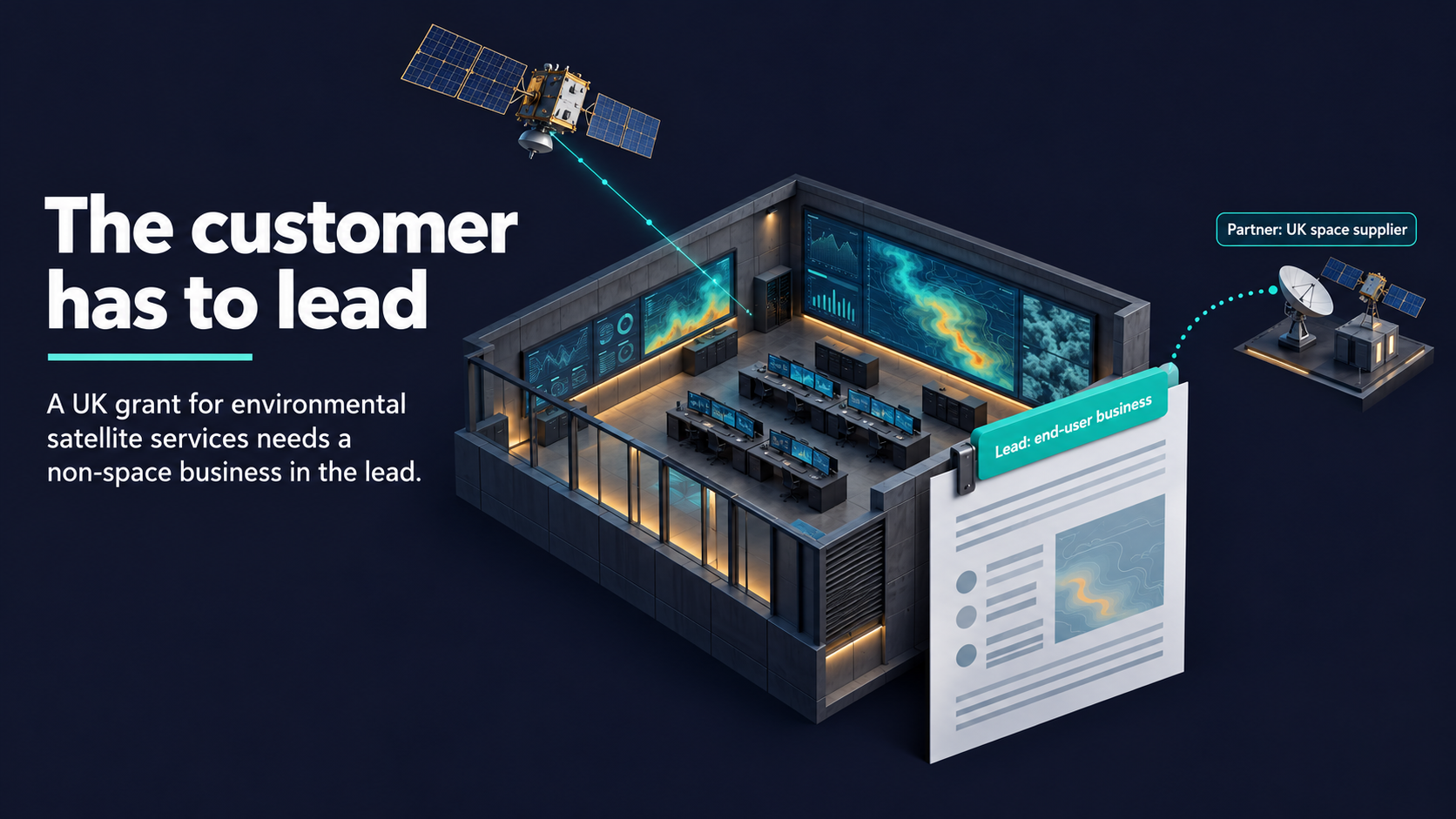
Space Insights editorial illustration of an end-user-led environmental satellite-services consortium; not a depiction of an awarded project or operational facility.
A satellite-data company with a strong product cannot apply on its own to the UK Space Agency's new Environmental Intelligence and Emissions Grant Call. A UK-registered end-user business from outside the space sector must lead, with at least one UK space supplier in the consortium. Public-sector organisations cannot lead, and solutions that only serve public-sector users are out of scope. Call guidance.
Published on 19 October, the call is the third round of the Unlocking Space for Business programme. The 2024 round awarded £2.5 million to ten end-user pilots and the 2025 round £1.5 million to six. This round offers up to £2 million in total and up to £400,000 per project. It also refers public-sector-only solutions to a separate route, Unlocking Space for Government. 2024 awards, 2025 awards.
What an application has to show
- A customer in charge. The end-user business submits the application, receives and distributes the funding and verifies expenditure at each milestone. Any match funding must be agreed and secured when applying; under the Minimum Financial Assistance route, an enterprise can receive up to £315,000 of such assistance in total over a rolling three fiscal years, including any previous MFA awards, without match funding.
- Near-market maturity. Projects start at Technology Readiness Level 5 or above and must reach at least TRL 7 within nine months, kicking off from mid-January 2027 and finishing by 30 September 2027.
- Early delivery. The first milestone falls on 31 March 2027 and should account for at least 25% of the grant, a profile UKSA links to its 2026/27 and 2027/28 financial years.
- Strategic fit first. Assessment weights strategic goals at 25%, impact at 20%, and innovation and feasibility, future investment and delivery at 15% each, with value for money at 10%. UKSA may adjust the ranking of fundable bids to cover its objectives.
Together, these rules move the test of demand to the start. A letter of support from a prospective customer is not enough: the customer carries the project, usually part of its cost and, in the end, the decision on whether to keep using the result. The first round shows what that can look like. UKSA reports that Equitix worked with Sust Global on wind-speed projections built from satellite data and geospatial AI, and incorporated them into its investment processes. UKSA case studies.
For a product team, the practical consequence is a change in the first conversation. The question is no longer whether a customer likes the data, but whether it will own a nine-month trial inside one of its own business processes.
Poland shows the public-user route
The agreement signed in Warsaw on 12 October between the Polish Space Agency and Wody Polskie, the state water-management authority, illustrates the path the UK call excludes. The two bodies plan to use satellite data for flood protection, drought, the monitoring of river ice in winter and, potentially, radar interferometry (InSAR) to track deformation of dams and other hydraulic structures. The work is described in the future tense, and no budget or procurement has been announced. POLSA announcement.
Here a public user helps define what the satellite products should do. That can give a product team valuable requirements, but under UKSA's business call, a solution designed only for users like Wody Polskie would be referred elsewhere. The two cases are a comparison of how users shape a product, not alternative routes into the same grant.
For non-UK suppliers, participation is a cost decision
Companies outside the UK may join a consortium but must fund their own participation; they cannot receive grant money from this call. International subcontractors need a justification of why the capability is not available in the UK. For a Nordic or continental supplier, joining therefore depends on the value of the UK customer relationship itself, not on the grant.
The briefing webinar is on Tuesday 3 November at 11:00 GMT, and clarification questions close on 27 November. Applications go through the DSIT Flexigrant portal and close at 16:00 GMT on Friday 11 December 2026, the date given in the call guidance and on UKSA's funding listing.
Successful applicants are due to hear in early January. Whether the funded pilots reach their first milestone in March, and whether the lead businesses keep the services after September, will show whether customer leadership produces adoption rather than just eligible applications.
Sources
- 1.USB Environmental Intelligence and Emissions Grant Call — UK Space Agency
- 2.Unlocking Space for Business: Environmental Intelligence and Emissions Grant Call (guidance) — UK Space Agency
- 3.Apply for funding: space-related R&D, innovation and education — UK Space Agency
- 4.£2.5 million for satellite data pilots to benefit citizens and businesses — UK Government
- 5.Space projects unlock climate and transport innovations — UK Government
- 6.USB Grant Case Studies: Overview of Grant Projects — UK Space Agency
- 7.Wody Polskie i Polska Agencja Kosmiczna łączą siły — Polish Space Agency (POLSA)
Get briefings like this every Friday.
Subscribe