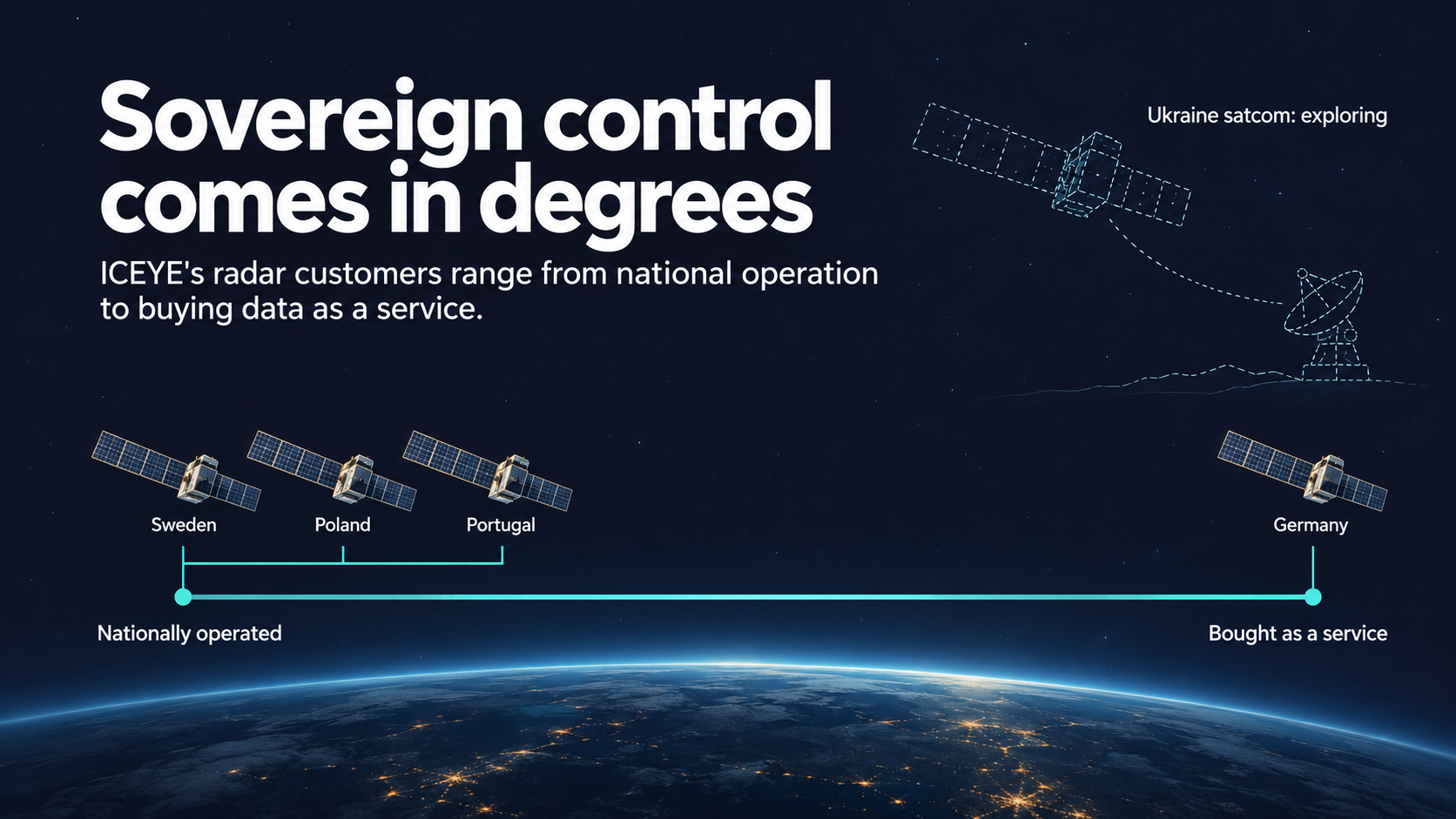
Space Insights editorial illustration comparing published satellite-control arrangements; the line is a conceptual comparison, not a quantitative ranking.
On 22 October, ICEYE and Nokia signed a letter of intent with Ukraine's Ministry of Defence "to explore cooperation in space", with sovereign satellite communications as the stated focus. No order, scope, financing or timeline has been published. The announcement is less a sale than a test of how far ICEYE's model for nationally controlled radar systems can travel into a different capability. ICEYE announcement.
That model is not a single arrangement. ICEYE's government customers have drawn the line between national control and supplier service in different places.
| Customer | What the published arrangement says | Stage |
|---|---|---|
| Sweden | The Armed Forces "will own and operate the system, ensuring sovereign control over tasking, data, and operational use" | Agreement announced January 2026 |
| Poland | "Polish military operators are fully trained and now run the constellation independently" | Handed over May 2026 |
| Portugal | CA-01, CA-03 and CA-04 acquired by CTI Aeroespacial (CA-03 and CA-04 with EU recovery-plan funding); CA-02 acquired directly by the Air Force; all operated by the Air Force | Four ICEYE-built satellites; the latest two in commissioning |
| Germany | The armed forces' procurement office buys reconnaissance data via exclusive access to a constellation that "remains the property of Rheinmetall ICEYE Space Solutions", which provides a service including full operations | Service contract awarded December 2025 |
Sources: Sweden, Poland, Portugal, 20 October, Portugal, 3 May, Germany.
For a government buyer, the substance sits in those columns: who sets tasking, who holds the data, who runs daily operations and who owns the asset. Sweden sits at one end of the range. Germany shows that a state can secure a national reconnaissance capability without owning the satellites at all.
Communications multiplies the layers
ICEYE and Nokia's 1 October partnership proposes systems that would give nations "ownership and control of the satellites, ground segment and terminals", with the first communications satellites expected in 2028. Compared with radar, the list of things a buyer must decide to control grows: terminals in the hands of users, the ground network that routes traffic and the security of the links between them. Nokia's role is described in general terms as secure networking; neither release sets out how the work is divided between the two companies. Partnership announcement.
The Ukraine release repeats that ownership language as a description of the partnership's offer, not as a scope agreed with Ukraine. What Ukraine has signed is an intention to explore.
The two companies also have a financial relationship that the partnership announcements do not mention. Nokia joined ICEYE's Series F round, announced in June, as a "new strategic investor". Seraphim Space Investment Trust, another ICEYE shareholder, confirmed on 10 September that the round had completed following the required regulatory approvals. June funding announcement, Seraphim RNS 2985U.
Portugal extends control into industry
Portugal's arrangement adds another layer. The two satellites that reached orbit on SpaceX's Bandwagon-5 mission on 20 October, designated CA-03 and CA-04 by the Portuguese Air Force, were acquired by CTI Aeroespacial under Portugal's New Space agenda with Recovery and Resilience Plan funding and will be operated by the Air Force. CTI Aeroespacial is a technology centre formed by the Air Force with CEiiA and Geosat. The new pair join CA-01, launched on 30 March and also acquired by CTI Aeroespacial (Air Force, 31 March), and CA-02, launched on 3 May and described by the Air Force as the first satellite it acquired outright from ICEYE. CA-03 and CA-04 had established communications and were undergoing the routine operations needed before entering service. Portuguese Air Force, 20 October, 3 May, CTI Aeroespacial.
ICEYE has also set up a Lisbon centre for software, systems integration and AI work. Its announcement places that centre alongside a satellite assembly, integration and test capability being developed by CTI Aeroespacial with the Air Force, with ICEYE as satellite and technology partner. Portugal is acquiring operations and part of the industrial chain, not satellites alone. ICEYE Portugal.
What the letter can and cannot show
The letter was announced during the Finnish Prime Minister's visit to Ukraine. It can reasonably be read as a political and commercial signal for a system that does not yet exist, from partners linked by investment. ICEYE's radar record shows it can deliver nationally controlled systems quickly; it does not show that a communications system, with field terminals and network operations, will follow the same timeline.
The more informative question is where a satcom customer would sit in the table above. A buyer that wants Swedish-style ownership of terminals and network operations is taking on a different programme from one that buys connectivity as a service from an industrial operator. A defined and funded scope from Ukraine, or from the first government customer of the ICEYE–Nokia system, will show which of those models the partners are actually selling.
Sources
- 1.ICEYE and Nokia partner with The Ministry of Defence of Ukraine to develop sovereign satcom capability — ICEYE
- 2.ICEYE and Nokia partner to launch secure and sovereign satellite communications for governments and defense customers — ICEYE
- 3.ICEYE to deliver sovereign space-based intelligence capabilities to the Swedish Armed Forces — ICEYE
- 4.ICEYE delivers MikroSAR system to Polish Armed Forces in under 12 months — ICEYE
- 5.ICEYE and Rheinmetall win major contract worth billions for space reconnaissance — ICEYE
- 6.Força Aérea reforça capacidade espacial com lançamento de dois novos satélites — Portuguese Air Force
- 7.Força Aérea assinala lançamento de mais um satélite da Constelação do Atlântico — Portuguese Air Force
- 8.Força Aérea assinala lançamento do primeiro satélite SAR português — Portuguese Air Force
- 9.Força Aérea, CEiiA e Geosat desenvolvem CTI Aeroespacial — Portuguese Air Force
- 10.ICEYE establishes ICEYE Portugal and Lisbon center of excellence to scale sovereign space capability — ICEYE
- 11.Completion of ICEYE Series F financing round and C Share conversion update (RNS 2985U) — Seraphim Space Investment Trust plc, via RNS
- 12.ICEYE leads a new era of sovereign intelligence from space with €1B funding round — ICEYE
Get briefings like this every Friday.
Subscribe