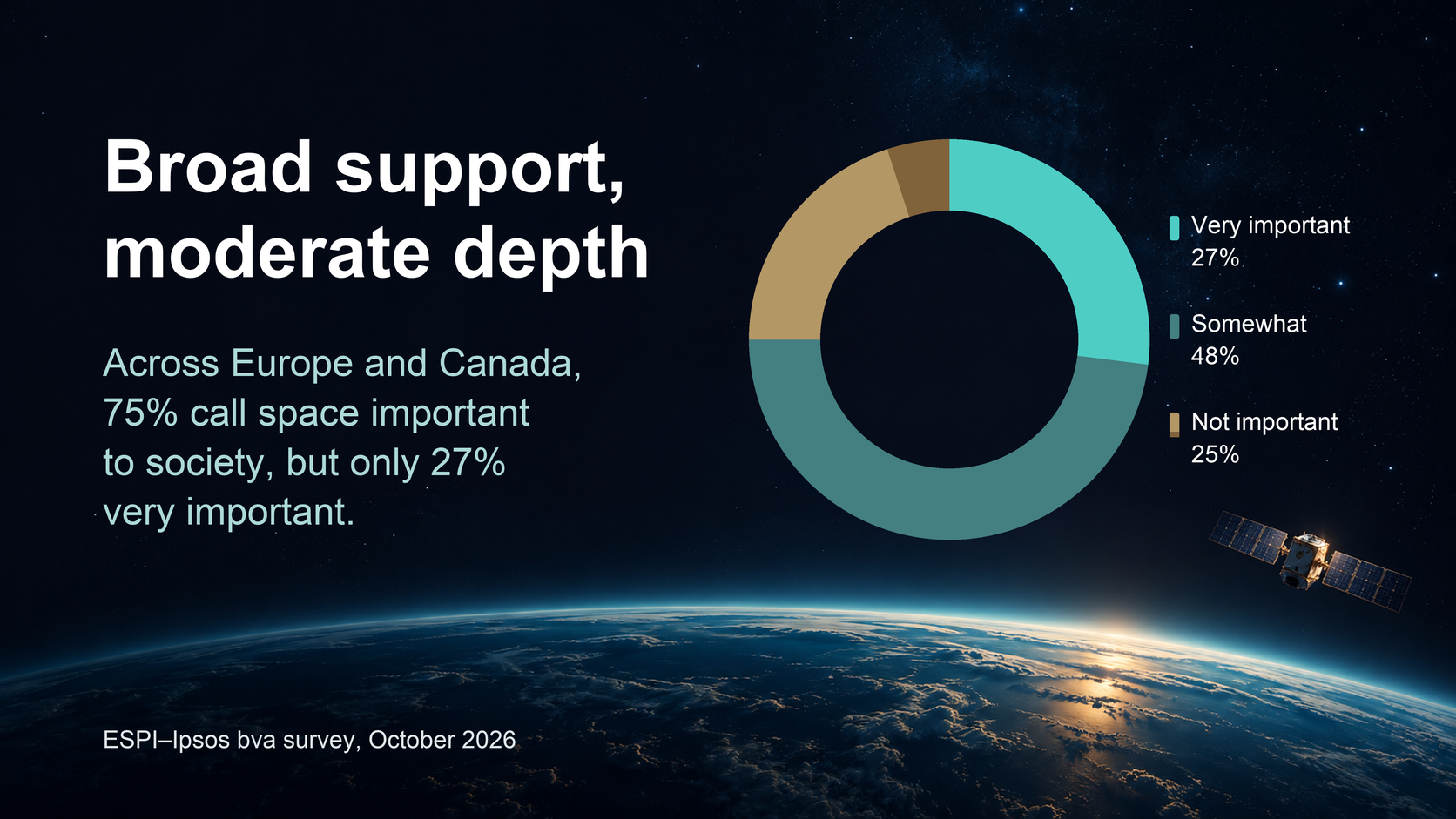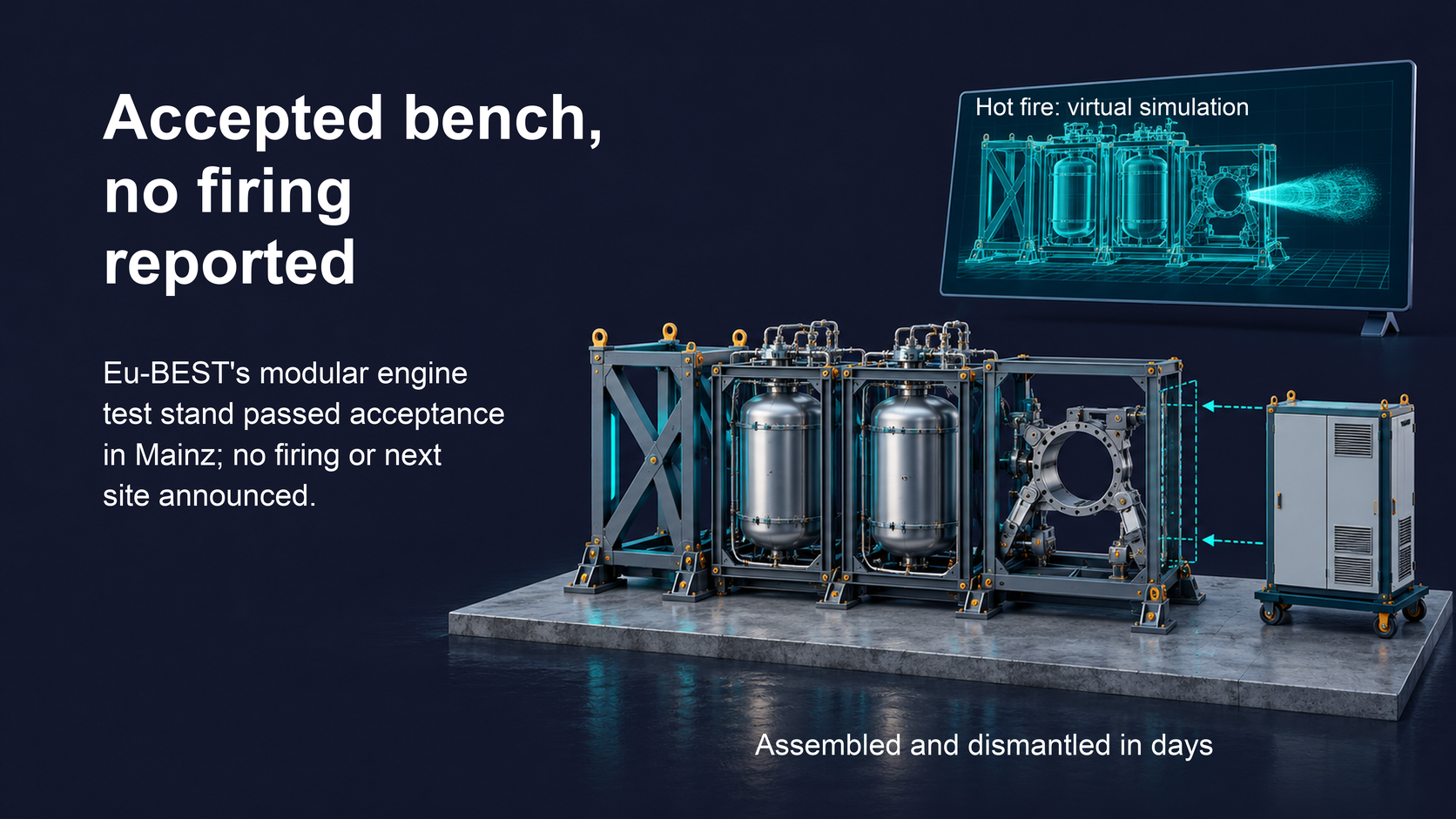
Space Insights editorial illustration of modular engine-test infrastructure and a virtual hot-fire simulation; not a photograph or an engineering drawing of the Eu-BEST bench.
On 22 October OHB announced that Eu-BEST, a €4.96 million Horizon Europe project, had ended with the "commissioning and final acceptance" of a full-scale rocket-engine test bench at OHB Digital Connect in Mainz. For engine developers, the result is a demonstrated way of building a test stand from standard modules. No permanent test site or operator has yet been announced. OHB announcement.
The gap is clearest when the project's 2023 plan is set beside what has been reported this month.
| Plan announced in December 2023 | Reported in October 2026 | |
|---|---|---|
| Site | Lleida-Alguaire airport in Catalonia, extending an existing engine test centre to 500 kN; a secondary site in Ireland | Mainz, at OHB Digital Connect; no next site named |
| Proof of concept | Hot fire of Pangea Aerospace's 300 kN ARCOS aerospike engine | Interface tests and a virtual hot-fire simulation on a digital twin |
| Mobility | Modular, relocatable bench | Assembled, interconnected and dismantled within a few days |
| Performance and price targets | Up to 500 kN, about 200 tests a year, a target of about €25,000 per test excluding propellants | No operator, tariff or booking route announced |
Sources: IEEC, December 2023, SUAS Aerospace, December 2023, Clemessy, December 2023, CORDIS, SpaceDreamS, October 2026.
What was demonstrated
Consortium partners report that the bench's main subsystems were installed and interconnected in Mainz and that interface tests were completed, "including a virtual hot-fire simulation". SpaceDreamS, which led the technical design and supplied the liquid oxygen and methane systems, says the bench was assembled, interconnected and dismantled within a few days, and that digital-twin models were used to simulate tests with different engines. No published statement reports an engine firing or a propellant flow test. The consortium's own update describes the bench's building blocks as "ready for hot-fire testing"; it gives no date or site for a first firing.
That is the layer that makes reuse possible. Standard interfaces and fast assembly separate the bench from any single site, and a digital twin lets a team rehearse a campaign before the hardware arrives. OHB Digital Connect also built a thrust-measurement system that reports the magnitude and direction of thrust in real time. Its measured performance has not been published.
What remains a plan
When the project was announced, the Catalan partners described a facility built on the existing test centre at Lleida-Alguaire that "will make its debut with the Pangea Aerospace's ARCOS engine". Clemessy, the coordinator, called that hot fire "one of the key points of the project". The completion announcement names Mainz only. It does not mention Alguaire, ARCOS or a date for a first firing.
The economic case also remains a set of targets. CORDIS lists up to 500 kN, around 200 tests a year and about €25,000 per test; Clemessy's 2023 announcement specified that the price target excluded propellants. These figures describe the intended service, not an operating record or a quotation, and no operator has been named to offer it.
What the result means for different readers
For a launcher or engine developer, no bookable test slot has been announced. Its value to that reader depends on where the bench is rebuilt, who runs it and when a real engine firing is reported.
For an airport authority, a regional spaceport or an infrastructure investor, it is evidence that an engine test stand can be designed as relocatable equipment rather than as a fixed facility built around one programme. In that model, a host site's contribution shifts towards utilities, safety arrangements and propellant logistics, with the bench itself arriving as modules.
There is also a less ambitious reading. Eu-BEST may remain a research demonstrator whose partners commercialise parts of the work through their own products. SpaceDreamS already markets a modular TestPad range for rocket-engine testing; its product page does not refer to Eu-BEST.
The grant period ends on 31 October. The project's final report on CORDIS, and any announcement from the partners or from Lleida-Alguaire, will show whether the accepted hardware becomes a working test site.
Sources
- 1.New standards for rocket engine testing: Eu-BEST project successfully completed — OHB
- 2.European Bench for Engine and Stage Testing (Eu-BEST), grant agreement 101135284 — CORDIS, European Commission
- 3.Clemessy coordinates the Eu-BEST consortium, to facilitate access to space in Europe — Clemessy
- 4.A consortium with participation of the IEEC, Pangea and Aeroports de Catalunya obtains 4.9 million from the EU for the Eu-BEST project — IEEC
- 5.SUAS Aerospace Part of €4.9M Team for Modular Space Launch Project — SUAS Aerospace
- 6.SpaceDreamS update on Eu-BEST interface tests in Mainz — SpaceDreamS
- 7.TestPad: modular test bench solutions for rocket engines — SpaceDreamS
Get briefings like this every Friday.
Subscribe