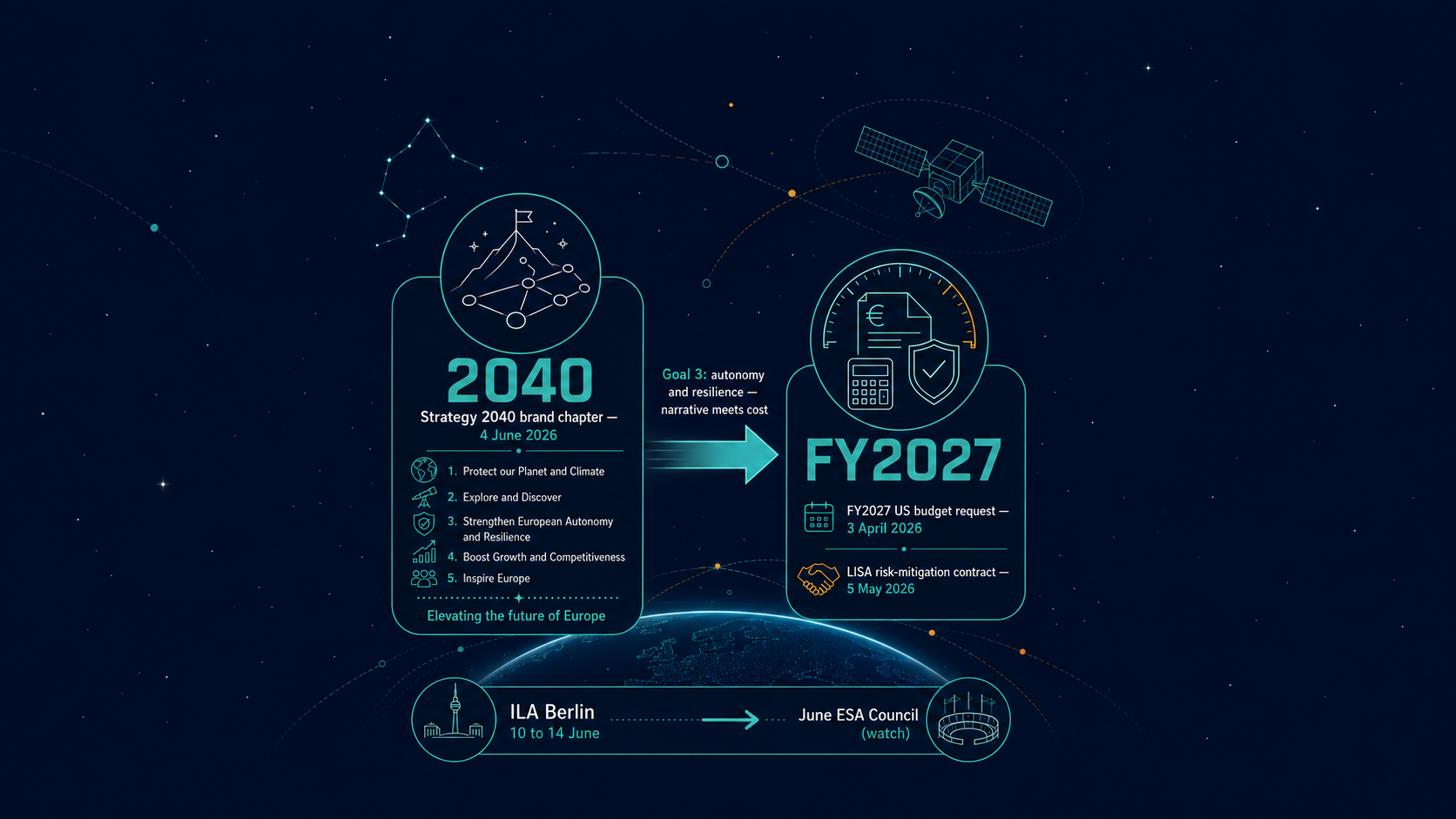
The EU's emerging European-operator preference for satellite services, read against mobile satellite spectrum allocation and Starlink expansion, late May 2026. Space Insights.
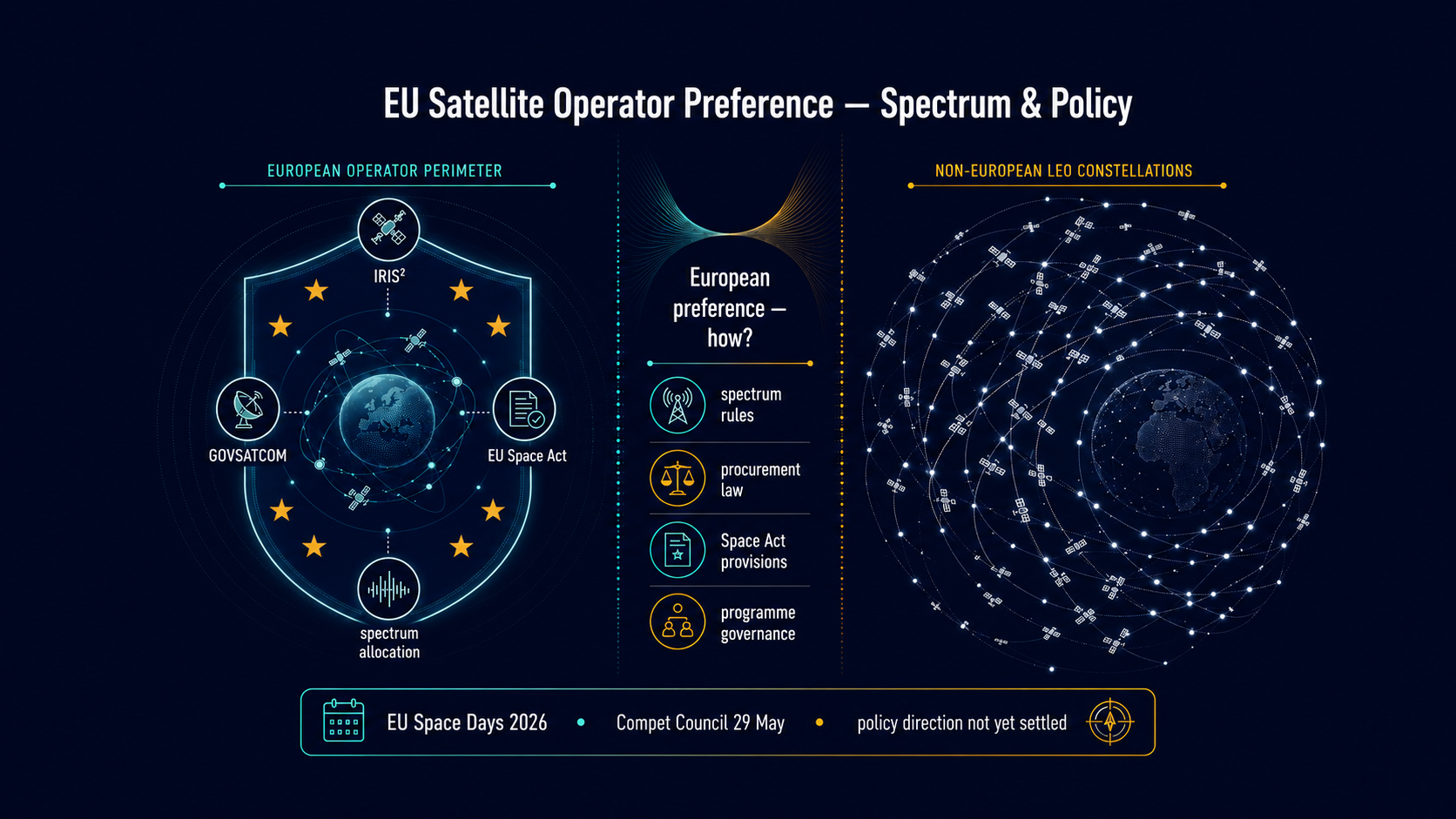
Euronews reported on 26 May 2026 that the European Union is preparing to favour European satellite operators, framed as a move to constrain Starlink's expansion in Europe. Reuters reporting the same week described the live policy area more specifically as future mobile satellite spectrum allocation, with the EU planning to reserve a significant share of that spectrum for European operators while non-European LEO players such as Starlink and Amazon may remain eligible for some access. Euronews framed the measure as potentially sensitive for the Trump administration. The report arrived alongside EU Space Days 2026 (26 to 27 May) and three days before the Competitiveness Council on 29 May, where the Cyprus Presidency briefed ministers on the EU Space Act progress report and the European Competitiveness Fund space part. The substance of how a European-operator preference would be operationalised — through spectrum-allocation rules, procurement law, sector-specific rules under the EU Space Act, or programme governance inside IRIS² and GOVSATCOM — is not yet settled in the public record.
In Space Insights' editorial reading, the signal is real but it should be read as an emerging European-operator preference whose legal and operational vehicle is not yet settled. The live policy instrument visible in public reporting is mobile satellite spectrum allocation; a confirmed EU-wide public procurement rule is not yet in the public record. This article reads the Euronews political framing and the Reuters live-instrument reporting against the EU secure-connectivity architecture as it stands at end-May 2026.
Source note: Euronews is the primary source for the political framing (European-operator preference, Starlink expansion framing). Reuters is used to identify the live policy instrument as mobile satellite spectrum allocation. Both are Tier 2 trade sources; the institutional surface is not yet in the public Council or Commission record.
What Euronews and Reuters reported, and what the public record does not yet say
The Euronews report (26 May 2026) describes the EU as preparing to favour European satellite operators, framing the measure as part of the political logic behind IRIS² and the EU Space Act, both of which already embed European industrial-policy objectives. Euronews framed the measure as potentially sensitive for the Trump administration, signalling that the report sees the preference as a transatlantic political question as much as a sectoral one.
Reuters reporting the same week (26 to 27 May 2026) described the live policy surface more specifically as future mobile satellite spectrum allocation, with the EU planning to reserve a significant share of that spectrum for European operators. Non-European LEO players such as Starlink and Amazon may remain eligible for some access under the framework described in the reporting. The 2GHz mobile satellite spectrum band is the technical scope visible in the Reuters reporting.
What the public record does not yet provide — at least at end-May 2026 — is the specific legislative or procedural vehicle through which a wider European-operator preference would be operationalised. The public record does not yet show whether the preference will operate through spectrum allocation alone, procurement rules, programme governance under IRIS² and GOVSATCOM, sector-specific provisions in the EU Space Act, or some combination. Until the institutional vehicle is named in a Commission communication, a Council document or a Presidency programme item, the substance of any wider preference cannot be assessed against a procurement-perimeter map.
Why the timing is structural, not coincidental
The Euronews and Reuters reporting appears in the same week as EU Space Days 2026 and three days before the Compet Council on 29 May 2026. That timing matters. EU Space Days served as the framing venue for the Cyprus Presidency's space policy priorities — modern harmonised space rules, strategic autonomy and innovation, per Deputy Minister Nicodemos Damianou's opening address. The Compet Council on 29 May then placed three legislative architecture files in the same institutional frame: the EU Space Act (regulation), the ECF space part (budget) and the proposed EU Space Services Agency (EUSSA) regulation (institution). The European-operator preference reported by Euronews and the mobile satellite spectrum allocation reporting from Reuters sit in the same political moment as these institutional moves.
In Space Insights' editorial reading, the European-operator preference framing is the political-economy layer of the same European space architecture project that the Council session foregrounded. The IRIS² programme (concession signed 16 December 2024 with the SpaceRISE consortium of Eutelsat, Hispasat and SES; first launch 2029; services from 2030) and the GOVSATCOM programme (operational since January 2026, with capacity contributed across participating Member States) are the operational surfaces of European secure connectivity. A European-operator preference — whether in spectrum allocation, procurement or programme governance — is the demand-side framing of the same architecture. The layers are consistent; whether they converge into a single binding rule, or remain parallel framings, is the open negotiation.
What the preference would and would not change
The structural effect depends on which instrument is formalised. The two reporting threads point in different directions.
If the preference is formalised through mobile satellite spectrum allocation — the live policy surface visible in Reuters's reporting — the immediate effect is on access to scarce satellite spectrum rather than on all public procurement. A more favourable access or positioning environment for European satellite operators would follow from reservation of a significant share of the 2GHz mobile satellite spectrum band, with non-European LEO players potentially eligible for some access under the framework described. Spectrum allocation directly shapes which operators can deliver mobile satellite services across the EU, but does not by itself create a demand floor across all EU public procurement.
If the preference is later extended into procurement rules, the effect would be broader — a more durable position for European satellite services in EU public procurement, particularly across institutional users (Member State administrations, EU agencies, secure-connectivity programmes and any users falling under harmonised EU procurement rules). This would only apply if the preference is formalised as a procurement rule, which is not yet visible in the public record.
The structural complexity — and this matters for sector planners — is that a European-operator preference in either spectrum or procurement does not by itself change the underlying European capacity perimeter. The European secure-connectivity stack draws on a combination of layers: IRIS² (services from 2030), GOVSATCOM (operational since January 2026, with capacity contributed across participating Member States) and the existing European LEO and GEO operator base. The non-European LEO constellations operate at a scale that European institutional preference rules cannot substitute for in commercial mass markets. A preference rule shifts the access or procurement perimeter; the wider commercial gap with non-European LEO scale remains a separate structural question that preference rules do not by themselves close.
How European operators and integrators can read this
For European operator commercial teams, Member State spectrum bodies and Member State procurement bodies, the immediate planning question is two-part.
First, watch for the live instrument. Mobile satellite spectrum allocation is the most visible surface in the public reporting; that is where European-operator preference rules can be expected to surface most quickly. The vehicle through which a wider European-operator preference would be operationalised — spectrum-allocation rules, Commission proposal on procurement, EU Space Act provision, procurement directive interpretation, IRIS²/GOVSATCOM governance rule — determines who is affected and on what timeline. Until each vehicle is named in a Commission communication, Council document or Presidency programme, the wider substance is open.
Second, watch the EU Space Act file. The EU Space Act (Cyprus Presidency progress report ST-8861-2026-INIT, scrutiny reservations upheld by all Member States, open issues on scope, dual-use exemptions, governance and third-country treatment) is one file to watch because it addresses market access, third-country treatment and the wider space-services regulatory frame. It is not yet identified as the vehicle for the reported preference. If the preference were to be incorporated through this file, it would be expected to surface in the Council text revisions through summer and autumn 2026 under the incoming Presidency. The Council outcome documents on the EU Space Act are one of the surfaces at which the substance of any wider preference would become readable.
What is uncertain
Three uncertainties are editorially material for sector planners.
First, whether the European-operator preference will be formalised as a binding EU rule at all, and through which instrument. The Euronews framing is "is preparing to favour"; Reuters specifies mobile satellite spectrum allocation as the visible instrument. The wider institutional substance — across procurement, programme governance and the EU Space Act — is not yet in the public record. The political logic is consistent with the broader Cyprus Presidency framing, but consistency is not the same as adoption.
Second, the transatlantic response. Euronews framed the measure as potentially sensitive for the Trump administration. The shape of any US response, and the EU's institutional handling of that response, is a structural variable that the preference file does not control by itself.
Third, the operational mechanics. The IRIS² concession is signed and in early deployment; GOVSATCOM is operational; the EU Space Act is in Council process. A European-operator preference inserted across spectrum-allocation rules, procurement, concession terms, programme governance and national sovereign procurement choices would interact with each surface in ways that are not yet visible.
Forward look
Among the most likely next venues at which the European-operator preference may surface in substantive form are the European Commission spectrum-allocation track (most visible in public reporting), the Council and Parliament work on the EU Space Act through summer and autumn 2026, the incoming Council Presidency's space agenda, and any Commission communication or non-paper that names a procurement or programme-governance vehicle. The Euronews framing is a political-economy signal that a European-operator preference is being prepared; the Reuters reporting points specifically to mobile satellite spectrum allocation as the live instrument; the wider institutional surface, once published, is what would tell European operators what each preference layer actually is and how it applies.
For European operators and integrators inside the secure-connectivity perimeter, the practical anchor is the spectrum-allocation track, the EU Space Act file and the Council outcome documents from the next Compet Council with a space agenda item. Until then, the wider preference is a framing surface; mobile satellite spectrum allocation is the most concrete live policy surface, not yet a confirmed EU-wide procurement rule. In Space Insights' editorial reading, the framing surface is real but the substance of any wider rule is open — and that distinction is the operative read for sector planners writing 2027 commercial assumptions.
Sources
- 1.EU to favour European satellite services to prevent Musk's Starlink expansion — Euronews
- 2.EU plans European-operator preference in mobile satellite spectrum allocation — Reuters (26-27 May 2026 reporting on EU mobile satellite spectrum allocation)
- 3.Competitiveness Council (Research and Space), 28-29 May 2026 — meeting page — Council of the European Union
- 4.EU Space Days 2026 — Cyprus Presidency programme — European Commission, DG DEFIS
- 5.IRIS² — Infrastructure for Resilience, Interconnectivity and Security by Satellite — European Commission, DG DEFIS
- 6.Council document ST-8861-2026-INIT — EU Space Act progress report — Council of the European Union
Get briefings like this every Friday.
Subscribe