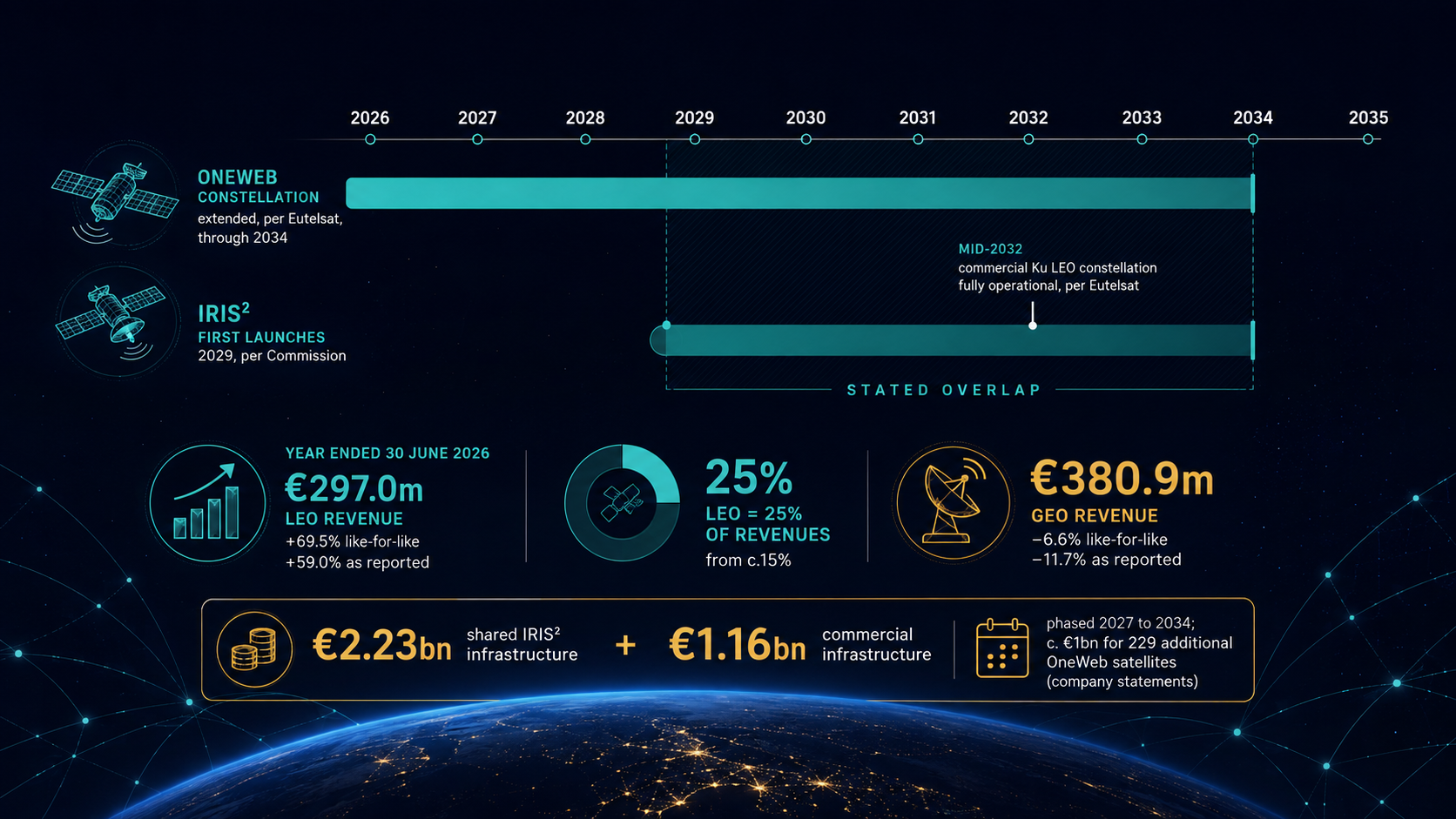
Eutelsat's disclosed schedule, OneWeb operating through 2034 and IRIS² first launches from 2029, creates a five-year transition window in which the two constellations run in parallel. Space Insights.
On 7 August 2026 Eutelsat published its full year 2025-26 results and, the same day, set out what it will invest in the next phase of IRIS². The two disclosures place a date on the far side of the transition: the OneWeb constellation is to be extended through 2034, by deploying an additional 229 satellites on top of the 440 new Generation 1 satellites already procured.
The results cover the twelve months to 30 June 2026 and were published on 7 August 2026; the release records that the accounts were reviewed by the Audit Committee on 5 August and approved by the Board of Directors of Eutelsat Communications on 6 August. Total revenues were €1,235.9 million, down 0.6 per cent on a reported basis and up 3.0 per cent like-for-like. Connectivity, the grouping that carries Government Services, Mobile Connectivity and Fixed Connectivity and which the company also reports split by orbit, stood at €677.9 million, up 9.7 per cent as reported and 16.4 per cent like-for-like. Within it, LEO revenue, which is the OneWeb business, reached €297.0 million, up 69.5 per cent like-for-like and 59.0 per cent as reported, and now accounts for 25 per cent of revenues against around 15 per cent a year earlier; GEO revenue was €380.9 million, down 6.6 per cent like-for-like and 11.7 per cent as reported. Every figure here is the company's own, as published in the results release and the accompanying results presentation.
The arithmetic
The Commission's 7 August announcement records that the European Commission and the SpaceRISE consortium signed the IRIS² implementation agreement, expanding the main constellation to 348 satellites, 330 in higher low Earth orbit and 18 in medium Earth orbit, and bringing first launches forward to 2029.
Eutelsat is a member of that consortium and describes its own role as lead of the LEO segment. On the same day, it states that it plans to strengthen and extend the OneWeb constellation through 2034.
Those two dates are five years apart. That is not a contradiction and it is not a prediction of delay. A constellation beginning to launch in 2029 does not require an existing one to stop, and an operating life stated to 2034 implies a period in which both are running. The overlap is arithmetic, drawn by placing two disclosed dates side by side.
The company has also disclosed the step in between. Its commercial Ku-band LEO constellation on IRIS² is stated to be fully operational by mid-2032. So the disclosed sequence reads: first launches from 2029, commercial IRIS² capacity fully operational by mid-2032, OneWeb running through 2034.
That sequence, rather than either date alone, is the more useful input for planning around European connectivity. The transition year tells you when one thing is stated to give way to another. The overlap tells you the shape of the market in between, and it is long.
The disclosed capital commitments
Eutelsat's disclosed commitments are phased to the same year. It will invest €2.23 billion in the shared infrastructure of IRIS² and a further €1.16 billion in the commercial infrastructure covering the Ku-band payload and commercial ground segment, phased over the period 2027 to 2034. The 229 additional OneWeb satellites represent an investment of around €1 billion. In the results release, the Group separately confirmed a medium-term plan covering investments of approximately €4 billion over the period FY 2026 to FY 2029, which the release states is funded by its recently completed €5 billion refinancing round. Gross capex for FY 2025-26 was €593.9 million, below the €900 million level anticipated at the half year, and the company expects gross capex in the region of €1.2 billion in FY 2026-27.
All of those are euro figures as Eutelsat reports them. The dollar totals that appear in trade-press accounts of the same disclosures are conversions rather than figures the company published.
Eutelsat Communications is listed on Euronext Paris and the London Stock Exchange under ETL, and the figures above are its own reported figures. What is worth recording is that the investment is phased to the same year as the stated operating life of the fleet it is intended to succeed.
The hosted payload, which may be the smaller and more interesting item
At its results call on 7 August 2026, asked about hosted payloads, Chief Executive Officer Jean-François Fallacher said: "we have signed a first contract. This one is confidential, we cannot communicate it. We have signed a first contract for hosted payload" (Eutelsat FY 2025-26 results call transcript, 7 August 2026; the call was also reported by Space Intel Report on 11 August 2026). The company published no value, counterparty or duration.
The reason it is worth flagging at all is structural. Hosting third-party payloads on a fleet with a stated operating horizon and a procured replenishment programme is a way of selling capacity whose end date is already known. If a constellation is stated to operate to 2034 and its successor programme is under a signed implementation agreement, capacity on it becomes a bounded, sellable thing in a way it is not while the horizon is open.
Whether this becomes a pattern for Eutelsat or for other operators facing the same transition is a question the disclosure leaves open.
The Space Insights read
The week's anchor signal was the IRIS² implementation agreement, signed at 348 satellites, with national commitments arriving underneath it; it is covered in a separate Space Insights signal this week, which carries the Commission primaries for those commitments. This is the commercial counterpart, published the same day from inside the consortium. Placing the two disclosures side by side is a Space Insights editorial reading; neither Eutelsat nor the Commission presents them as a single package.
Sovereign programmes are usually discussed as though they replace what came before on the day they arrive. The disclosed dates say otherwise. Between first IRIS² launches from 2029 and OneWeb's stated horizon through 2034, the parties themselves describe a transition window, with mid-2032 the point at which the company states its commercial IRIS² capacity is fully operational. On the dates disclosed, procurement decisions, capacity contracts and integration work falling in that window would be taken against two constellations rather than one.
That is the framing this publication would apply, and it follows from the two sets of disclosures rather than from either of them.
Sources
- 1.Full Year 2025-26 Results — Eutelsat
- 2.Full Year 2025-26 Results (press release, full text, 7 August 2026) — Eutelsat
- 3.Full Year 2025-26 Results presentation (7 August 2026) — Eutelsat
- 4.Eutelsat to play central role in delivering the next phase of Europe's sovereign IRIS² connectivity infrastructure — Eutelsat
- 5.European Union accelerating and reinforcing IRIS² — European Commission, DG DEFIS
- 6.Eutelsat Communications H2 2026 earnings call transcript, 7 August 2026 — StockAnalysis
- 7.Eutelsat: we signed 1st OneWeb hosted payload; OneWeb Gen 1 to operate to 2034, then IRIS²; $5.07B in capex to 2034 — Space Intel Report
Get briefings like this every Friday.
Subscribe