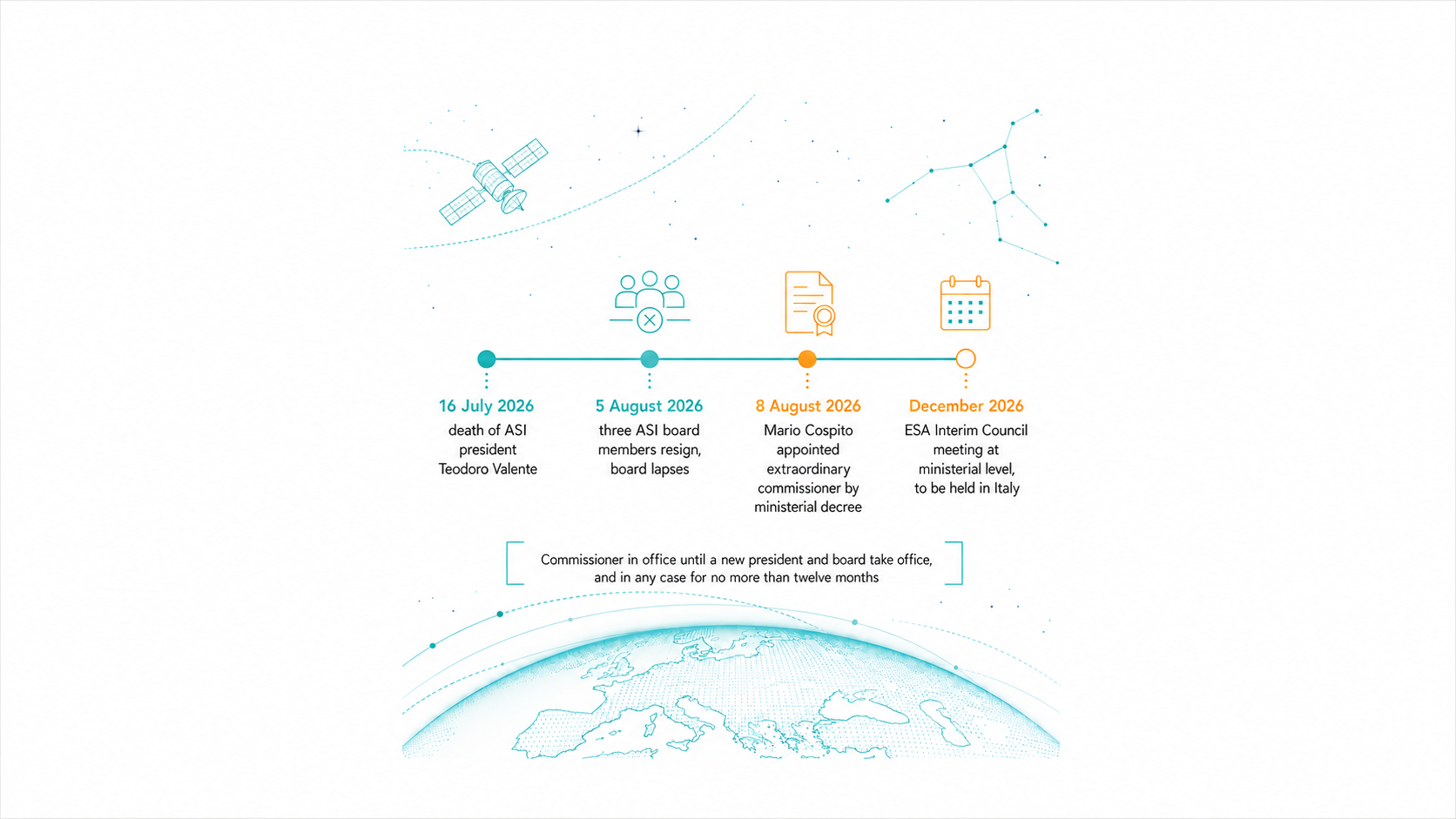
The dated sequence at ASI: president Teodoro Valente's death on 16 July, three board members resigning on 5 August, and Mario Cospito's appointment as extraordinary commissioner on 8 August, four months before Italy hosts the ESA Interim Council at ministerial level in December. Space Insights.
Ambassador Mario Cospito was appointed extraordinary commissioner of the Italian Space Agency on 8 August 2026, by decree of Adolfo Urso, Minister of Enterprises and Made in Italy, with duties of ordinary and extraordinary administration. ASI describes the appointment as an important step to maintain the functionality of the agency, and states that the commissioner remains in office until the date the new president and new board of directors take up their posts and, in any case, for a period not exceeding twelve months.
ASI president Teodoro Valente, who had led the agency since 2023, died on 16 July 2026.
What the primary record sets out
The sequence is documented, and each step is dated in ASI's own releases.
On 5 August 2026, ASI's deputy vice-president Elda Turco Bulgherini, who had taken on the president's functions after 16 July, and board members Stefano Gualandris and Stefano Arcifa resigned from the board of directors, which caused the board to lapse. ASI states that the three stepped down to allow the agency, which will be engaged in the coming months in managing important national, European and multilateral events, to return to operating in the full range of its functions as soon as possible, under a new president and a renewed board. ASI further records that the situation and the resulting institutional steps were the subject of a briefing given to the Council of Ministers by Urso in his capacity as Delegated Authority for space and aerospace policy.
Three days later, the ministerial decree appointing Cospito was issued.
ASI's biography of the commissioner sets out the record in dated terms. Cospito entered the Italian diplomatic service in 1985 and reached the rank of ambassador. He served as diplomatic adviser to the Deputy Minister with responsibility for foreign trade and subsequently to the Minister for International Trade from 2001 to 2008; as Ambassador of Italy in Bucharest, also accredited to the Republic of Moldova, and as Ambassador of Italy in Stockholm; and, from 2013 to 2016, on secondment to the Ministry of Economic Development. He took up the post of vice-president and head of institutional relations at Avio S.p.A. in 2021. Since 2022 he has been diplomatic adviser to the Minister of Enterprises and Made in Italy and, in that minister's capacity as Delegated Authority, his adviser on aerospace policy.
Urso stated that the choice rested on Cospito's long institutional experience and his knowledge of the space sector, gained first at Avio and then as diplomatic adviser at the ministry with direct responsibility for the space dossier, and that those competences are valuable "in a strategic phase for Italian space, with the ESA Council presidency and the important international appointments Italy will host in the coming months" (per Italpress, 8 August 2026). In the same statement Urso said that the selection procedure provided by law for identifying the agency's new president would be started immediately.
Two points follow from that, and both matter for how the appointment should be read. The twelve months is an outer limit rather than a term: on the minister's own account, the statutory procedure that ends it was to begin immediately. And the reason given for the appointment, in ASI's release, is the functionality of the agency; the ESA calendar appears in the minister's statement as the context that makes the appointee's experience valuable, not as the stated cause of the appointment. Reporting that treats the ESA presidency as the reason the appointment was necessary is a characterisation rather than a quotation.
The calendar, precisely
The calendar itself is documented, and it is worth stating precisely.
Italy holds the presidency of the ESA Council at ministerial level for the current three-year period, a mandate that runs to the ministerial council Italy is due to host in 2028, per the Ministry of Enterprises and Made in Italy (1 July 2026). ESA's own record of the opening of the Bremen meeting states that Urso "was elected Chair of CM25, the ESA Council at Ministerial level" (ESA, 26 November 2025), and ESA's record of the closing press conference the following day names him as Chair of CM25 alongside Director General Josef Aschbacher and Germany's Federal Minister of Research, Technology and Space Dorothee Bär in the host role (ESA, 27 November 2025). The Ministry of Enterprises and Made in Italy records the same step as the "unanimous designation" of Urso as president of the Council (27 November 2025). This is distinct from the ESA Council chair at delegate level, a separate office held by Juan Carlos Cortés since 1 July 2026, following Renato Krpoun.
At its 347th meeting, held at ESA headquarters in Paris from 16 to 17 June 2026, the Council agreed that the Interim Council meeting at ministerial level will be held in December 2026 in Italy. ESA's framing of its purpose is specific: the Interim Ministerial "will provide an important opportunity for Member States to define the European exploration roadmap for the coming years". Italian reporting places the meeting in Rome on 15 December 2026 (per Avionews, 8 July 2026); ESA's own release states the month and the country and not the day or the city.
An interim ministerial is not a full subscription round. The subscription round was CM25 in Bremen, where ministers approved €22.3 billion, the largest set of contributions in ESA's history, per ESA press release N° 79–2025 of 27 November 2025. ESA recorded at the same meeting that subscriptions to the European Resilience from Space initiative would remain open into the following year to let participating states accommodate the new programme. So the December meeting carries a programmatic agenda that ESA has defined as the exploration roadmap, alongside a subscription window ESA left open. Placing those two next to each other is a Space Insights reading; ESA's release does not connect the open subscription window to the December meeting.
At Bremen the two roles sat with different Member States: Germany hosted, Italy chaired. In December, Italy will hold both the host role confirmed by ESA and the Council presidency described by the Italian government. ESA has not separately identified the chair of the Interim Ministerial in its June announcement.
What to watch
Two observable things, both of them institutional rather than personal.
The first is the selection procedure for the permanent presidency. Urso stated on 8 August that it would start immediately. Whether it concludes before or after the December meeting is a checkable fact with a date attached to it, and it determines whether Italy arrives at the meeting it hosts with a commissioner or a president at the head of its agency. Nothing in the public record settles that yet.
The second is what Italy tables in December. ESA has defined the meeting's purpose as the European exploration roadmap. The Italian position going into a meeting Italy hosts, and where it also holds the Council presidency, is the kind of input that is visible in advance to anyone reading the agency and ministry releases, and it is the thing that ministerial outcome coverage tends to reconstruct afterwards.
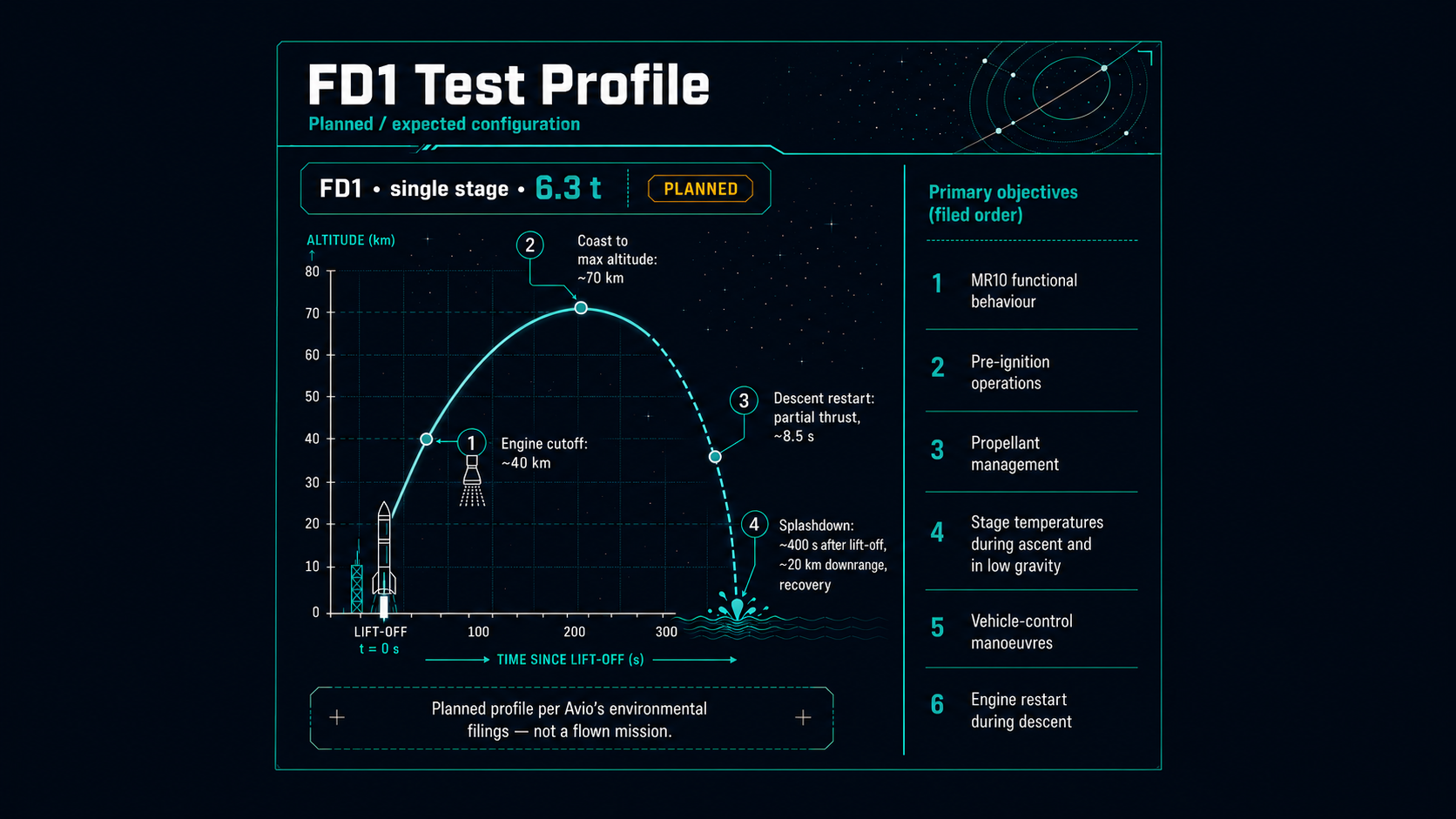
One factual connection to note plainly, because it also appears in this week's separate signal on Avio's FD1 demonstrator: Cospito took up the post of vice-president and head of institutional relations at Avio S.p.A. in 2021, per ASI's biography. It is recorded here as biography, so that a reader encountering both pieces is not left to discover the overlap unaided.
Sources
- 1.Agenzia Spaziale Italiana: nominato il nuovo Commissario straordinario — Agenzia Spaziale Italiana
- 2.Agenzia Spaziale Italiana: dimissioni di tre componenti del Consiglio di Amministrazione — Agenzia Spaziale Italiana
- 3.The Italian Space Agency announces the passing of President Teodoro Valente — Agenzia Spaziale Italiana
- 4.N° 31–2026: Key outcomes of the 347th ESA Council meeting — European Space Agency
- 5.N° 79–2025: ESA Member States commit to largest contributions at Ministerial — European Space Agency
- 6.ESA's Ministerial Council begins in Bremen — European Space Agency
- 7.Outcomes of CM25 are announced in Bremen — European Space Agency
- 8.Spazio: conclusa la ministeriale ESA di Brema. Urso, "Italia torna protagonista nello spazio" — Ministero delle Imprese e del Made in Italy
- 9.Spazio, Urso incontra DG ESA Aschbacher: "Ruolo guida dell'Italia" — Ministero delle Imprese e del Made in Italy
- 10.Urso nomina Mario Cospito commissario straordinario Agenzia Spaziale Italiana — Italpress
- 11.Conferenza ministeriale intermedia Esa a Roma il 15 dicembre — Avionews
- 12.Italy appoints career diplomat as space agency extraordinary commissioner — European Spaceflight
Get briefings like this every Friday.
Subscribe