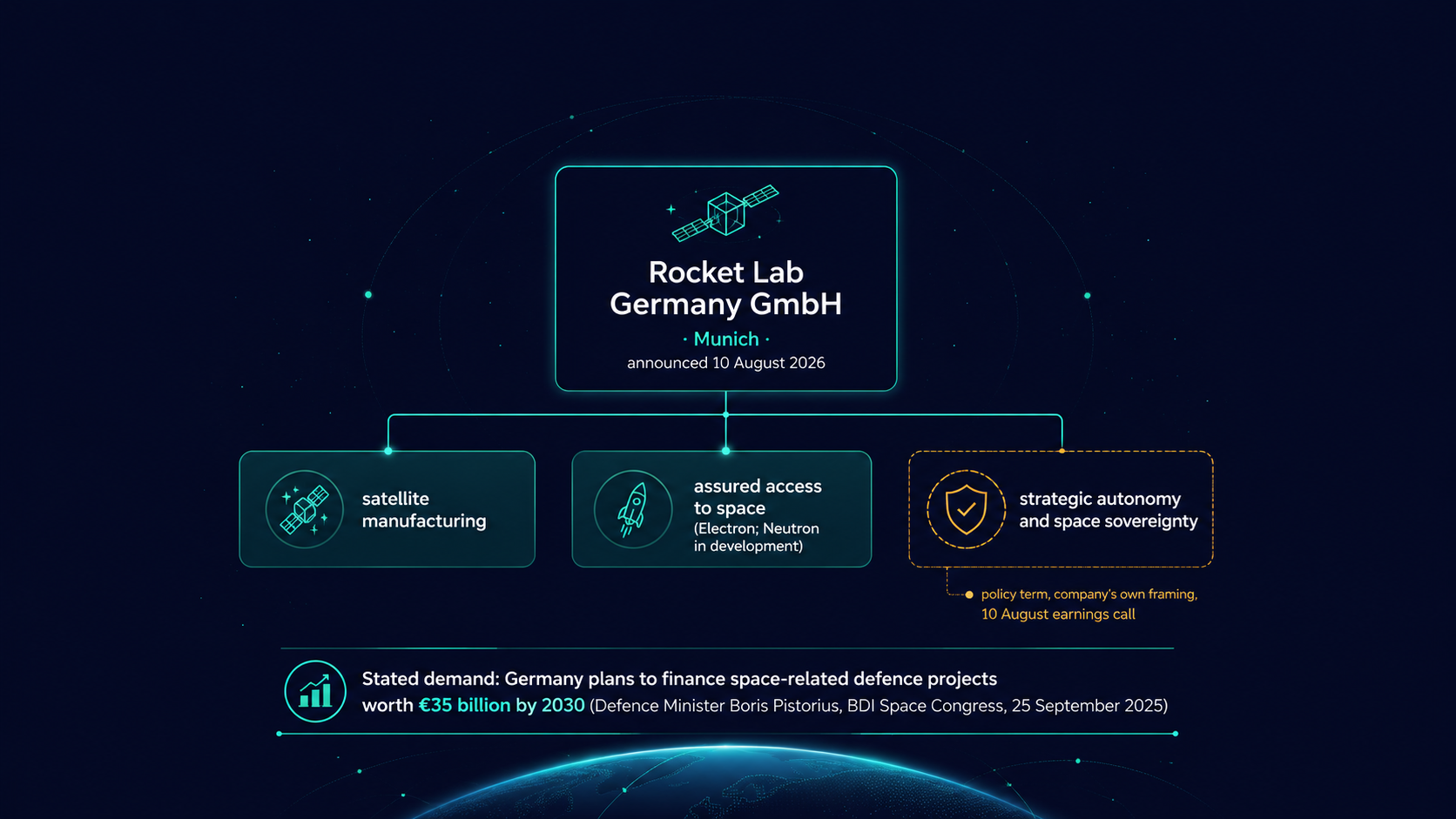
Rocket Lab's Munich subsidiary carries three stated pillars, satellite manufacturing, assured access to space and strategic autonomy, against a German defence financing plan announced separately and a Mynaric acquisition already cleared in March. Space Insights.
Rocket Lab Corporation (Nasdaq: RKLB) formally announced Rocket Lab Germany GmbH on 10 August 2026. Per the company's release, the Munich-based subsidiary is intended to enable scaled domestic production of satellites and their critical components, and to deliver launch services on Electron and on Neutron, the latter still in development, and to give European programmes "assured access to space". On the same day's earnings call, per European Spaceflight's 12 August report, Rocket Lab set out three pillars for the German entity: satellite manufacturing, assured access to space, and strategic autonomy and space sovereignty.
Read as a business story, this is unremarkable and sensible. A launch and satellite manufacturer expands in a market where the national government has announced a large space-related defence investment. Companies do this.
Read as a signal, the third pillar is the one worth stopping on.
Commercial capability and policy vocabulary
Satellite manufacturing describes a capability Rocket Lab sells. Assured access to space and strategic autonomy also carry established European policy meaning, and neither is a neutral phrase in that register. Both appear in European industrial policy, in defence procurement debates and in the argument for programmes like IRIS². They carry an implication about control, not only about location.
Rocket Lab's own release uses both terms in that register. It states that "Europe is increasingly focused on strengthening its strategic autonomy and sovereignty in space", and it is titled around delivering sovereign space capabilities to Europe. Founder and chief executive Sir Peter Beck is quoted in the release describing "a profound structural shift toward an era defined by speed, commercial agility, and absolute technical sovereignty".
A subsidiary registered in Germany, manufacturing in Germany and serving German requirements would be a real industrial presence. What has been announced is narrower than that. The release states that the company "is also pursuing opportunities that could lead to the establishment of satellite, payload, and components manufacturing in Germany", and describes the entity as supporting "potential future scaling" of Rocket Lab satellite and component manufacturing there; per German company records reported by European Spaceflight, the registered Munich address appears to be a serviced-office location rather than a dedicated Rocket Lab facility. The production already running in Germany under Rocket Lab ownership is Mynaric's: the release says Mynaric will continue to produce its optical terminals, with Rocket Lab increasing their scale and efficiency. The open question is whether presence of that kind, at whatever scale it reaches, satisfies a sovereignty requirement, and the answer depends on how the requirement is written.
Across Europe it is not yet written the same way twice. Some formulations turn on where value is added; others on where control ultimately sits; others on whether technology can be withheld by a third-country government. A US-parented entity registered in Munich reads differently under each.
Germany has screened this company once already
The entity is not quite as new as the announcement. Per German company records reported by European Spaceflight, Rocket Lab Germany GmbH was created from a pre-existing shelf company, Mondstein 694 GmbH, whose shareholders approved the change of name and business purpose on 27 March 2026, with the change reflected on 2 April. The 10 August release is the formal announcement, not the incorporation.
Nor is it Rocket Lab's first German step. On 30 March 2026 the company announced that its acquisition of Mynaric AG, the Munich-based supplier of laser optical communications terminals, had been reviewed and approved by Germany's Federal Ministry for Economic Affairs and Energy, with closing expected in April and Mynaric continuing to be headquartered in Munich. Rocket Lab described that transaction as establishing its first European footprint, and the 10 August release refers back to it as a foothold already in place.
That sequence is useful because it separates two instruments that are easily conflated. A foreign-investment review asks whether a non-European acquirer may take control of an existing German asset, and Germany answered that question in March. A procurement eligibility rule asks something different: whether a supplier counts as European for the purposes of a specific programme. Clearing the first does not answer the second.
Why it is a test of definitions
Rocket Lab has expanded in Germany naming the policy objective that European sovereignty programmes exist to serve, and pointing at a national budget line as the demand signal.
The budget line is the German government's, not the company's. Speaking at the third BDI Space Congress in Berlin on 25 September 2025, Federal Minister of Defence Boris Pistorius set out a national security architecture in space covering satellite constellations, ground stations, secure launch capabilities and services, and said: "To this end, we are investing a great deal of money. Until 2030, we plan to finance projects worth 35 billion euro."
On the 10 August earnings call, Beck put it differently. Per European Spaceflight, he said that "Germany has put over $40 billion into a satellite missile warning system, along with other things, and typically that would have been outsourced to other nations". European Spaceflight reported that he appeared to be referring to the €35 billion commitment. The two statements are not the same statement. One is a financing plan running to 2030 across a defined architecture; the other speaks in past tense, foregrounding a missile-warning system while adding "along with other things". A demand signal a company has named is not a contracted programme, and the distance between those two things is where most of the risk in this story sits.
The Space Insights editorial read is that this puts a question to European procurement that European procurement has mostly been able to leave open. As long as sovereign capability and European-owned capability described roughly the same set of companies, the difference between them did not need resolving. A Munich subsidiary of a US-parented company can separate the two, and it arrives at the moment Germany has announced a very large number.
What to watch
Two markers, neither of them conclusions.
Whether other non-European primes take the same route. A subsidiary is a low-cost way to test an eligibility boundary, and if it proves effective it is easily copied.
And whether the €35 billion converts. It is a financing plan to 2030 announced by a defence minister, and the observable checkpoints are the contracts placed against it rather than the headline figure. The same test applies to the Munich subsidiary: the checkpoint is a manufacturing site and the work placed in it, not the registration.
Sources
- 1.Rocket Lab Establishes Rocket Lab Germany to Deliver Sovereign Space Capabilities to Europe — Rocket Lab Corporation (via GlobeNewswire)
- 2.Rocket Lab Receives Regulatory Approval to Acquire Mynaric — Rocket Lab Corporation (via GlobeNewswire)
- 3.Rocket Lab Establishes German Subsidiary — European Spaceflight
- 4.Englische Rede: Verteidigungsminister Pistorius beim BDI-Weltraumkongress 2025 — Bundesministerium der Verteidigung (BMVg)
- 5.Germany Commits €35 Billion to Space-Related Defence Projects — European Spaceflight
Get briefings like this every Friday.
Subscribe