KSAT and iQPS: The Ground-Segment-as-a-Service Bet Behind a 36-Satellite SAR Constellation. Space Insights.
According to iQPS's own announcement of 3 June 2026, reported the following day by SatNews, Japan's iQPS extended its long-term partnership with Norway's Kongsberg Satellite Services (KSAT) at a signing ceremony at the Meiji Kinenkan in Tokyo, and will adopt KSATlite as the ground backbone for its planned constellation expansion. KSAT is the Norwegian ground-station operator owned in a 50/50 joint venture by Kongsberg Defence & Aerospace and the state-owned enterprise Space Norway; KSATlite is its fully automated ground-station service designed for small satellites and mega-constellations. The headline is a partnership renewal. The substance is a ground-segment procurement model: iQPS is scaling through KSATlite rather than announcing a proprietary global ground-network build-out.
That distinction is the reason this signal matters beyond the two companies involved. As synthetic aperture radar (SAR) constellations scale from a handful of satellites into the dozens, the ground segment becomes a major operational and capital-planning constraint. How that constraint is handled shapes who can compete.
What was actually signed, and by whom
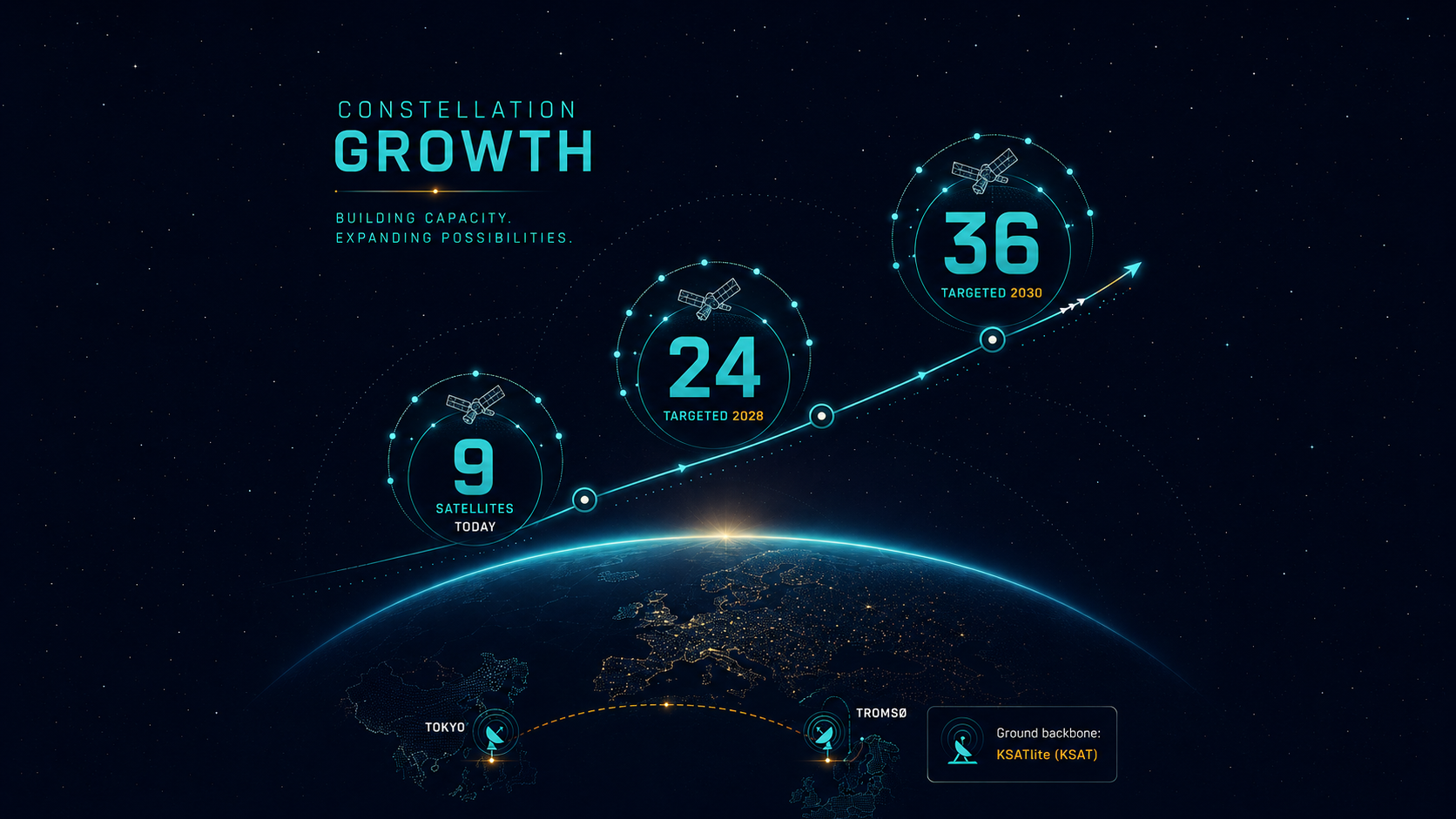
iQPS, the Institute for Q-shu Pioneers of Space, operates the QPS-SAR constellation: small synthetic aperture radar satellites that image the Earth's surface day or night and through cloud cover. The company currently has nine commercial satellites in operation. It targets 24 satellites by late May 2028 and 36 by 2030, supporting an observation interval the company describes as an average of around 10 minutes.
The agreement was signed by Dr. Shunsuke Onishi, President and Representative Director and CEO of iQPS, and by KSAT's President and CEO Marte Indregard. The signing was honoured by the presence of Mr Fredrik Steen, Minister-Counsellor of the Royal Norwegian Embassy in Tokyo, and Mr Wataru Takahama, Director of the Space Industry Division at Japan's Ministry of Economy, Trade and Industry (METI). The official presence gives the signing a visible bilateral context, but no public government statement was identified assigning a specific policy meaning to the agreement.
The partnership is not new. As Onishi put it, "KSAT has been a crucial part of our SAR mission since our second mission, providing Launch and Early Orbit Phase (LEOP) support and its ground network for mission-critical operations." The extension adds KSATlite as the explicit backbone for the scale-up to 36 satellites. Kenneth Olafsson, Head of KSAT Asia and Representative Director of KSAT Japan, framed it from the KSAT side: "KSAT is honored to continue supporting iQPS's rapidly scaling QPS-SAR Project."
Why the ground-segment-as-a-service choice is the real signal
A constellation operator has two ways to handle ground contact. It can build and maintain a proprietary global antenna network, or it can buy ground contact as a service from an operator that already runs one. The first is a capital programme with a long lead time and a global real-estate and licensing footprint. The second converts that into an operational expense that scales with the constellation.
iQPS has chosen the second. By adopting KSATlite, iQPS can rely on an existing global ground-network service as its constellation scales, instead of publicly committing to build and operate an equivalent proprietary network. The public announcement does not disclose commercial terms, but the service model points to a more scalable ground-operations path than a standalone ground-network build-out. For an operator moving from nine satellites to 36 inside roughly five years, the appeal is straightforward: the ground segment can grow at the pace of the constellation rather than ahead of it.
This is the structural reason the signal is worth more than a routine contract renewal. It is a data point in a broader shift in how Earth observation constellations are financed. The satellites are increasingly the differentiator; the ground segment is increasingly something an operator buys rather than owns. KSAT's KSATlite offering sits on the supply side of that choice, as a network available to operators at constellation scale.
Space Insights cross-file editorial read: how this fits KSAT's Japanese EO positioning
The iQPS extension does not stand alone. In the same week, KSAT announced expanded partnerships with two other Japanese Earth observation operators: SAR operator Synspective and optical microsatellite operator Axelspace, both dated 3 June 2026 and both built around KSATlite. Read together, these three agreements are consistent with KSAT becoming one of the more visible ground-network partners for Japanese Earth observation operators scaling toward constellation size. This is a Space Insights editorial reading across the week's three KSAT announcements, not a single primary-source statement; the source path is the iQPS, Synspective and KSAT (Axelspace) press releases, all dated 3 June 2026.
For the Nordic space sector, this is the quieter half of a story usually told through launch and manufacturing. Norway's space-industrial strength has long sat in the ground segment and in polar and Arctic station geography, which is well suited to the frequent contacts that low-Earth-orbit constellations require. The KSATlite model packages that geographic and operational advantage into a service that an operator in Tokyo can buy without building anything in the Arctic. On a Space Insights reading, the commercial value of Nordic ground infrastructure is increasingly exported as a service rather than as hardware. This ground-segment-as-a-service framing is a Space Insights editorial read of the recurring Nordic ground-segment pattern, not a claim made in the primary press releases.
There is a dual-use dimension worth naming plainly. SAR Earth observation is widely understood as dual-use: the same all-weather imaging that serves maritime monitoring, disaster response and agriculture also has defence and security applications. This article therefore treats the agreement as an industrial and ground-segment infrastructure signal, not as a defence-policy decision.
What to watch next
The near-term test is delivery against the published roadmap: the step from nine satellites to 24 by late May 2028 is the larger of the two jumps and the one that would show whether the service-based ground model holds up under rapid constellation growth. If the scale-up proceeds smoothly, it would provide another public data point for ground-segment-as-a-service as a credible model for mid-sized Earth observation constellation operators.
The second thing to watch is whether KSAT's run of Japanese Earth observation partnerships consolidates into a recognised ground-network position or whether competing providers contest it. The commercial logic that makes the service model attractive to iQPS makes it attractive to others, and ground-segment provision is itself a competitive market.
What remains uncertain is the financial shape of these arrangements. Neither company has disclosed contract values, and it would be speculative to infer them. The strategic direction is legible from the public facts; the economics are not yet, and this analysis does not guess at them.
Sources
- 1.iQPS Signs Further Long-Term Partnership Agreement with KSAT (Kongsberg Satellite Services) — iQPS, Inc.
- 2.KSAT and iQPS Expand Strategic Alliance to Accelerate High-Frequency SAR Constellation — SatNews
- 3.KSAT and Axelspace Expand Strategic Partnership to Accelerate Earth Observation Business through Microsatellite Constellation — Kongsberg Satellite Services (KSAT)
- 4.Synspective and KSAT Expand Strategic Alliance to Enhance SAR Satellite Operations and Global Data Delivery — Synspective
Get briefings like this every Friday.
Subscribe