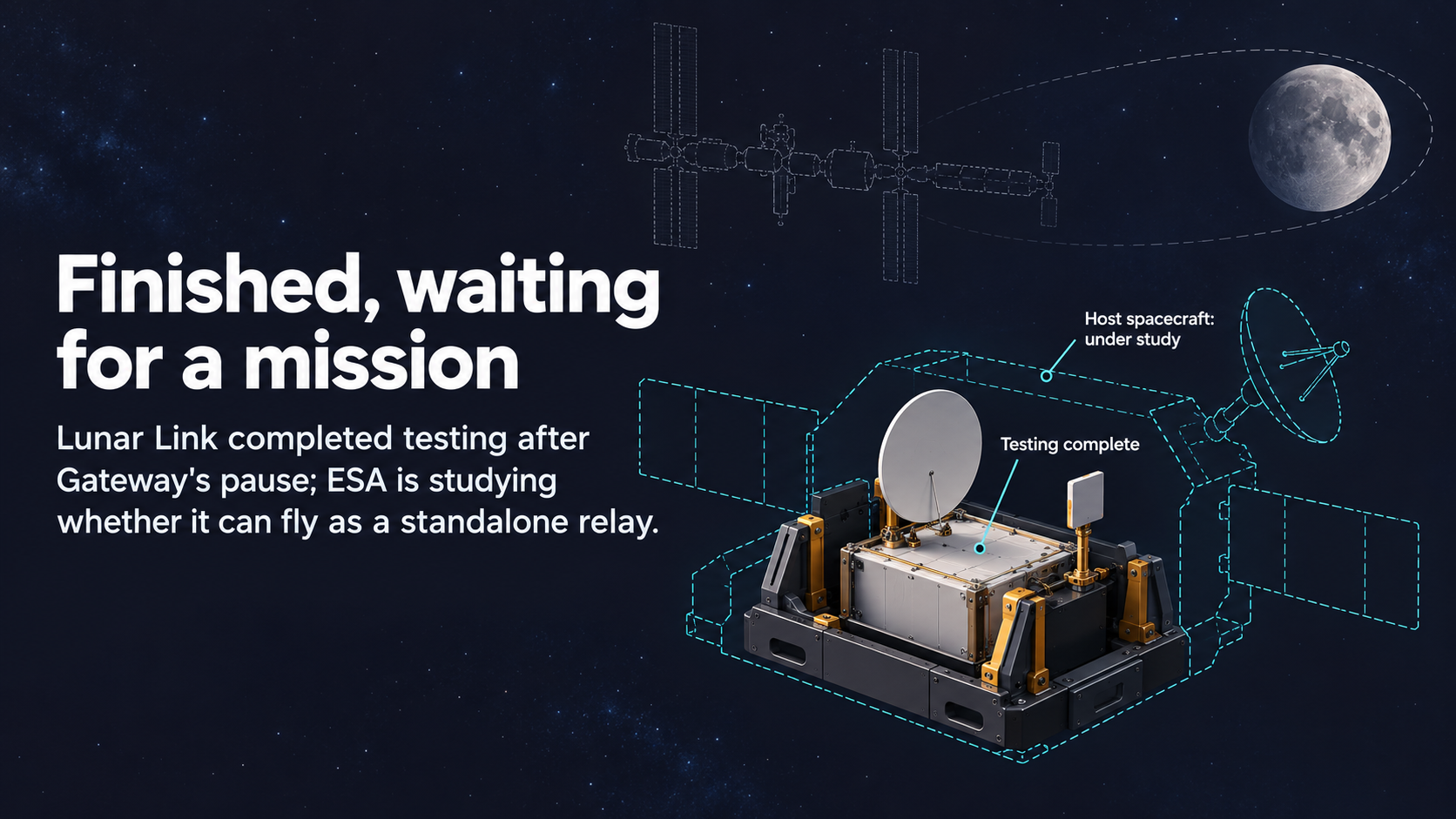
Space Insights editorial illustration of completed Lunar Link hardware and a possible future host; not an approved spacecraft design or mission architecture.
When NASA paused Gateway in March, ESA's Lunar Link was "only three months away from completion". The final test campaign was already under way and test facilities were reserved, so ESA and its industrial team chose to finish it. On 20 October ESA reported that the system had completed its last major integration and testing campaign at Thales Alenia Space in Cannes, including an end-to-end test with a team from NASA's Johnson Space Center. ESA report.
A finished element without its host
Lunar Link was built for HALO, the Gateway module from which it would have connected the orbiting station with explorers on the Moon. On 24 March NASA said it "intends to pause Gateway in its current form and shift focus to infrastructure that enables sustained surface operations", repurposing applicable equipment. NASA announcement.
In September, ESA and prime contractor Thales Alenia Space began the qualification and acceptance review, which is expected to finish by the end of the year. After a final software update, the flight hardware will be placed in controlled storage, where ESA says it will remain "in flight-ready condition while its future is decided". Teams from Thales Alenia Space in France, Belgium, Spain and Italy, MDA in the United Kingdom and SENER in Spain contributed to the build.
Both partners are looking to reuse Gateway hardware
NASA is already drawing on hardware developed for HALO itself. On 4 August it said that three Northrop Grumman lunar-surface demonstration payloads in development, starting with systems designed to survive the lunar night, "build on power and avionics hardware developed for the Gateway program's HALO" module. NASA update.
ESA's route is different. In July it issued an invitation to tender for studies on how Lunar Link could be repurposed. Mounted on a platform with an additional antenna for an Earth link, ESA says, "it could become an independent communication relay" for future Moon missions by ESA and its partners. The studies will assess spacecraft concepts, orbits, schedules and possible cooperation with ESA's Moonlight programme.
The difference matters for European suppliers. NASA is redirecting subsystems into surface demonstrations that already have a destination and a contractor. Lunar Link has completed its payload work, but before it can deliver a service it needs a spacecraft to carry it, a launch and an operator. No choice or funding decision for any of them has been announced. Finishing the hardware preserved the investment and its qualification evidence; it did not create a mission.
Where it could fit, and where it is not assigned
OASIS shows how ESA is approaching the surface side of the same problem. On 19 October OHB announced feasibility and preliminary design studies for a lunar service station that would supply shared power, communications and data storage to several payloads. ESA's baseline targets at least 75 W of continuous power during the lunar day and 15 W during the lunar night. Current plans envision delivery by Argonaut and relay communications through Moonlight, starting with Lunar Pathfinder. OHB, ESA.
Neither ESA nor OHB mentions Lunar Link in connection with OASIS. A standalone Lunar Link relay would therefore have to find its place within, or alongside, a lunar communications architecture that already has planned elements. That is the question the repurposing studies have to answer.
The political timetable frames the decision without settling it. ESA's Council, meeting on 21 and 22 October, discussed the Director General's proposal for Europe's future in space exploration, described as a scalable path in low Earth orbit, on the Moon and towards Mars. It described the Intermediate Ministerial Meeting in Rome on 15 December as "a key step towards the programme and financial decisions at CM28", one that would also enable early preparatory activities "within existing financial envelopes". The Council outcome does not mention Lunar Link. ESA Council outcomes.
The next markers are specific: completion of the acceptance review, the award and results of the repurposing studies, and what ministers decide to fund at CM28. Until then, Lunar Link is a fully tested European asset waiting for a spacecraft.
Sources
- 1.Lunar Link complete and ready for a new adventure — European Space Agency
- 2.NASA Unveils Initiatives to Achieve America's National Space Policy — NASA
- 3.NASA Provides Updates on Moon Base Cargo Landers, Tech Demonstrations — NASA
- 4.On the way to a European lunar infrastructure: ESA awards OHB OASIS studies — OHB
- 5.OASIS: a European service station for the Moon — European Space Agency
- 6.Key outcomes of the 350th ESA Council meeting — European Space Agency
Get briefings like this every Friday.
Subscribe