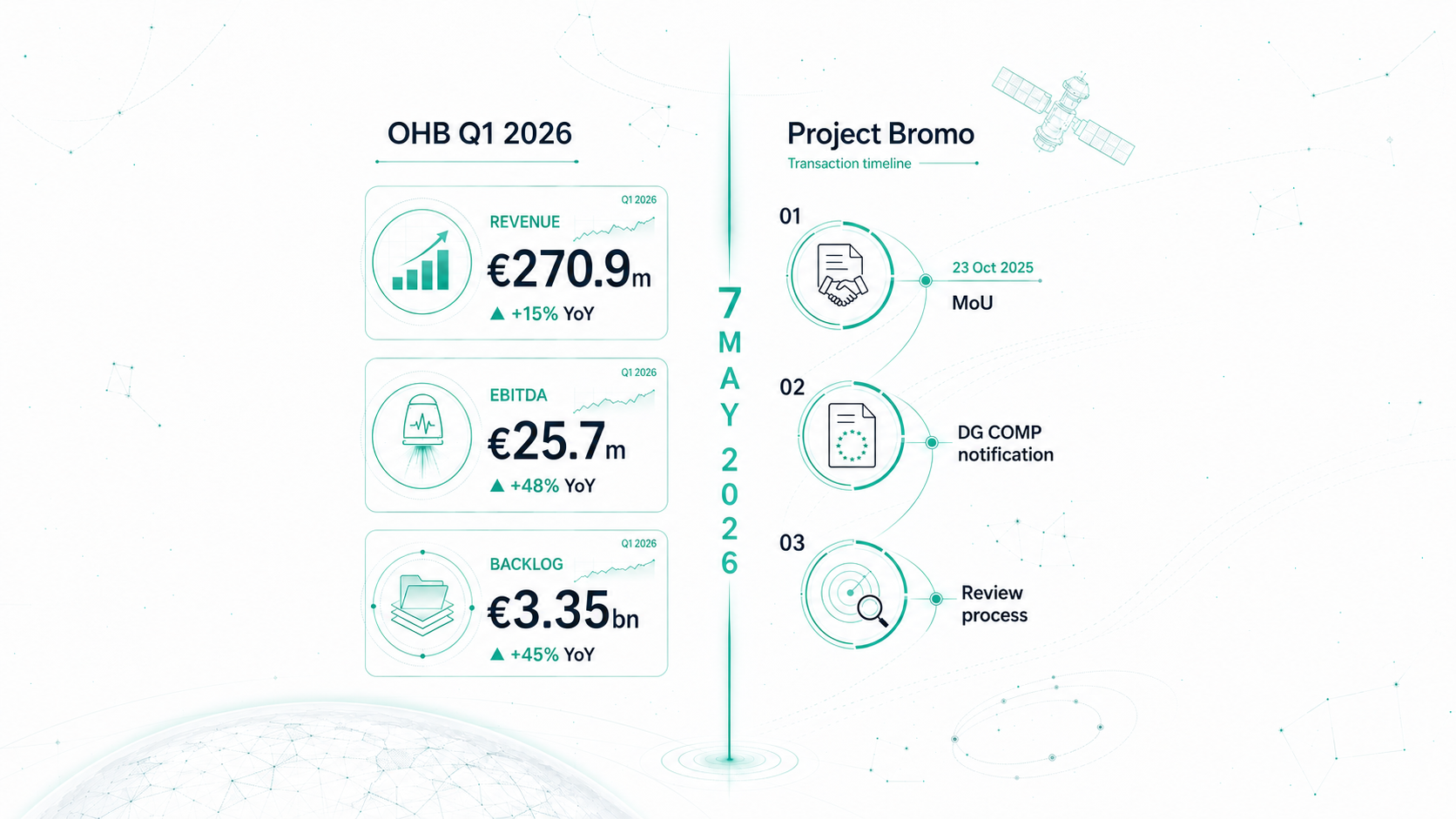
Marco Fuchs, OHB SE CEO, signals legal action on Project Bromo while OHB's Q1 2026 backlog rises 45% year on year to €3,354M, including a €248M EPS-Sterna constellation contract at OHB Sweden. Space Insights.
Marco Fuchs, OHB SE's chief executive, told Reuters on 7 May 2026 that OHB will consider legal action if the European Commission clears the proposed combination of the Airbus, Thales and Leonardo satellite businesses known internally as Project Bromo. The same day, OHB filed its first-quarter 2026 results, with total operating performance up 15 percent year on year to EUR 279.3 million, an order backlog of EUR 3,354 million, and an EUR 248 million EPS-Sterna microsatellite-constellation contract booked at OHB Sweden. The pairing is the message: the commercial heft behind the legal posture, on a single news cycle.
What Project Bromo is and where it stands
Airbus, Leonardo and Thales signed a memorandum of understanding on 23 October 2025 to combine their satellite-manufacturing and space-services businesses into a single European prime, per the joint Amsterdam-Rome-Paris release. The contributions are specific: Airbus brings its Space Systems and Space Digital businesses from Airbus Defence and Space; Leonardo brings its Space Division, including its shareholdings in Telespazio and Thales Alenia Space; Thales brings its shares in Thales Alenia Space, Telespazio and Thales SESO. Space launchers are excluded from the perimeter. Ownership is set at Airbus 35 percent, Leonardo 32.5 percent and Thales 32.5 percent under joint control with balanced governance.
The combined entity, code-named Project Bromo internally and not yet publicly branded, would consolidate one of the largest combined satellite-manufacturing perimeters in Europe into a single structure. The transaction is in the European Commission's competition-review process. No formal Phase II decision has been published at the time of writing.
OHB SE, the Bremen-headquartered prime with multi-country subsidiaries, is the primary independent European satellite manufacturer outside Project Bromo's perimeter. It is also one of Project Bromo's structural counterparties: OHB sources sub-systems from Thales Alenia Space (a Thales 67 percent / Leonardo 33 percent joint venture inside the Bromo perimeter), OHB Italia operates ESA programmes including the Ramses asteroid mission, and OHB Sweden's recent EPS-Sterna win demonstrates the EUR 248 million end of the European microsatellite market.
What Marco Fuchs actually said
Per Reuters reporting on 7 May, Fuchs, in his capacity as OHB CEO, indicated OHB would consider legal action if the merger is cleared and described the proposed combination as "rather a disturbance of the market" with downstream supply-chain impact. The framing is institutional, not personal: the Reuters report quotes Fuchs in his executive role and on the firm's behalf, not in a regulatory-filing capacity.
The legal threat is not a filing. It is a public statement of intent, conditional on the Commission's eventual decision. In competition-law practice, a public statement at this stage signals to the Commission that an interested third party is preparing to use the Article 263 TFEU annulment route, or to participate as an interested party in the Phase II investigation, or both.
Why the Q1 release matters
Two days of context turn the legal posture into a market-shape signal rather than a corporate-affairs comment. Per OHB SE's Q1 2026 release of 7 May, adjusted EBITDA rose 37 percent to EUR 27.3 million, total operating performance rose 15 percent to EUR 279.3 million, and the order backlog stood at EUR 3,354 million — a 45 percent year-on-year increase. The backlog detail matters most. EPS-Sterna, OHB Sweden's microsatellite-constellation contract at EUR 248 million, is described in the OHB release as the subsidiary's largest order to date. OHB Italia's ESA construction-phase contract for the Ramses asteroid mission, signed at ESTEC on 10 February 2026 at EUR 81.2 million, builds on the October 2024 preparatory contract and brings the mission's total value to approximately EUR 150 million (per ESA primary). And the European Moonport Company, established earlier in 2026 to consolidate OHB's lunar-infrastructure activities into a single subsidiary, sits alongside these awards.
The implication for the Bromo competition review is structural. OHB's commercial position has materially expanded between the October 2025 MoU and the May 2026 Q1 release. The Commission's competition assessment will need to weigh the European institutional satellite market not at the moment the MoU was filed but at the moment of decision. A growing independent prime is a different counterfactual from a static one.
What it does not say
The Reuters report does not record a Commission position. The OHB Q1 release does not contain a forward-looking statement on Project Bromo. Marco Fuchs's comment is a public statement of intent, not a filing. None of these are predictions of what the Commission will decide, and treating them as such would mistake posture for outcome.
It is also worth noting what OHB does not allege publicly. The Reuters quote does not cite specific Article 102 TFEU concerns, does not name particular product markets where competition would be diminished, and does not specify the supply-chain dependencies Fuchs cited as "impacted". Those details, if they exist, will surface in any Phase II filing or in third-party submissions to the Commission. They are not yet on the public record.
Forward look
Three things to watch. First, the Commission's procedural milestones in the Bromo review: notification, Phase I conclusion (clearance, conditional clearance, or move to Phase II), and any third-party submissions during the consultation periods. Second, OHB's next quarterly disclosures: whether the EPS-Sterna and Ramses points develop into a sustained backlog trend or are concentrated in the first half. And third, the EU Space Act's progression — the Cyprus Presidency progress report (ST 8861/26 of 8 May 2026) records that all Member States have maintained scrutiny reservations and several issues remain open. The regulatory framework that will govern the post-Bromo market structure is itself in motion.
The reasonable read of 7 May is that European space-industrial policy now has two major moving files — Project Bromo's competition review and the EU Space Act's Council progress — and one independent prime willing to engage publicly on both.
Sources
- 1.Germany's OHB to consider legal action if EU clears Airbus-Thales-Leonardo satellite merger — Reuters
- 2.Germany's OHB to consider legal action if EU clears Airbus-Thales-Leonardo satellite merger (Reuters wire — open access) — U.S. News (Reuters wire)
- 3.OHB plans to push back on the Airbus-Thales-Leonardo merger — Payload Space
- 4.OHB SE Q1 2026 results: strong, profitable growth — OHB SE / WebDisclosure
- 5.Airbus, Leonardo and Thales sign Memorandum of Understanding to create a leading European player in space — Airbus / Leonardo / Thales
- 6.ESA awards contracts for Ramses mission to Apophis — European Space Agency
- 7.EU Space Act — Cyprus Presidency progress report (ST 8861/26) — Council of the European Union
Get briefings like this every Friday.
Subscribe