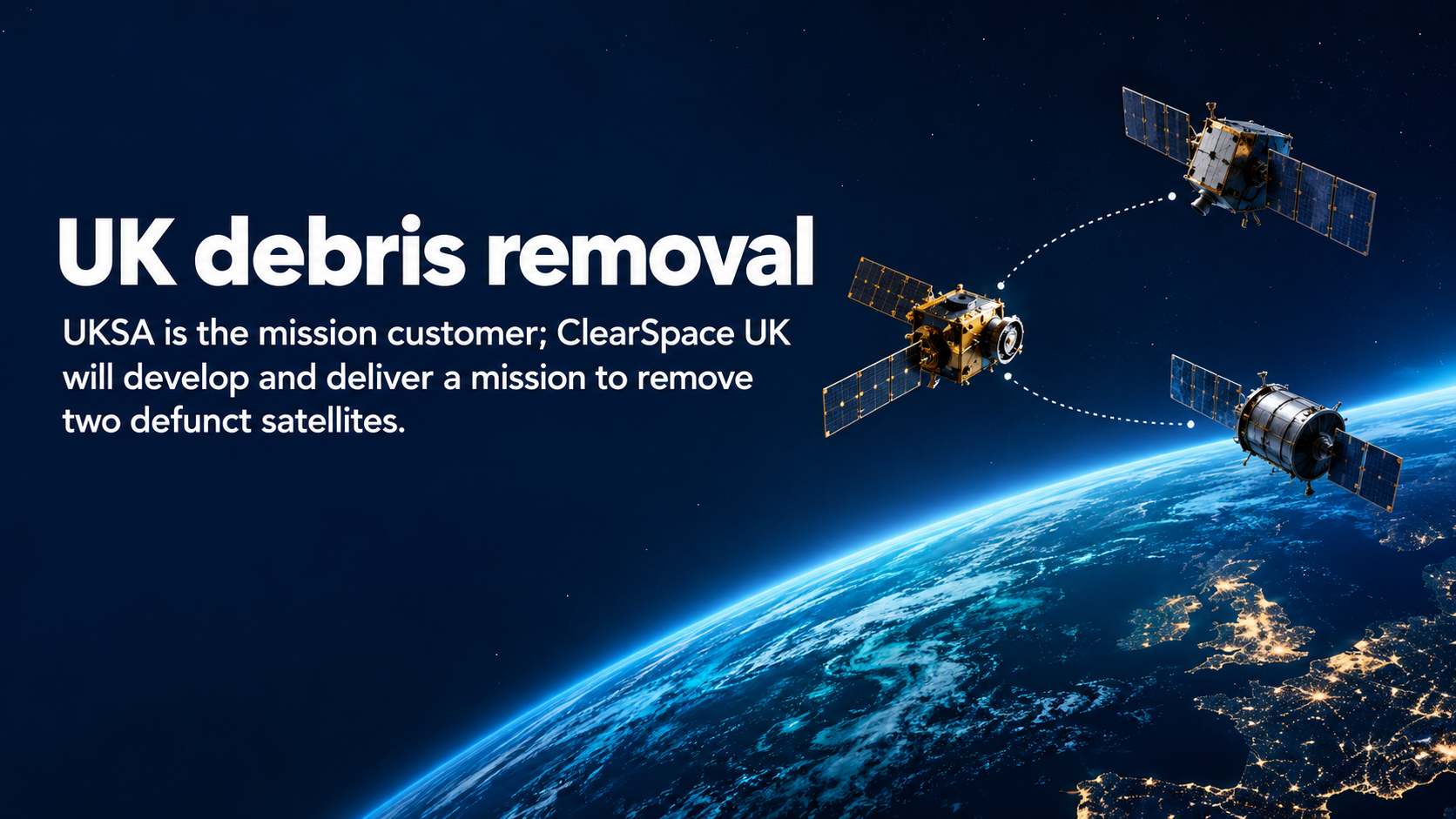
Space Insights editorial illustration of orbital debris removal; not a depiction of the final mission spacecraft or target satellites.
The UK Space Agency has commissioned a £61 million mission to remove two defunct satellites, with ClearSpace UK responsible for design, development and delivery. Announced on 15 October, the contract gives orbital servicing a concrete instance of national demand: a public customer specifying a result and appointing a prime contractor to deliver it. ClearSpace announcement.
The government plans a 2029 launch and removal of both UK-registered satellites by 2032. Alongside the removal task, the programme is intended to establish experience in approaching and capturing objects that were never designed to be serviced. The public purchase combines an environmental outcome with the development of national capability. UK Government announcement.
That combination helps explain the award's significance within a sector where technology development, institutional missions and commercial service agreements often appear under the same heading. Three recent examples reveal different reasons to commit money, engineering effort or a customer relationship.
Three commitments, three purposes
| Programme or agreement | Publicly disclosed commitment | What it establishes |
|---|---|---|
| UK Active Debris Removal | £61 million national mission contract; ClearSpace UK is prime | A government customer has commissioned removal of two satellites and the associated mission capability. |
| Phoenix | ESA contract with ClearSpace, signed on 22 September 2026 | Funding for spacecraft design and technology maturation towards integrated demonstrations. |
| SES / Infinite Orbits | Agreement announced on 13 November 2025 for one GEO life-extension mission | A named operator has agreed a service mission, with docking envisaged after an in-orbit demonstration. |
Sources: ClearSpace, ESA, SES.
These commitments provide different evidence of demand. UK ADR has a specified public mission to fulfil. Phoenix has institutional support to mature a capability. The SES agreement connects life extension to the continued operation of an existing commercial asset. Treating all three as equivalent customer orders would conceal the differences in what each buyer or partner is trying to achieve.
Life extension starts with a different economic problem
Phoenix addresses satellites whose communications payload can remain useful as their propellant runs low. Its servicing spacecraft would support manoeuvres that keep the client correctly positioned and oriented. The concept accommodates existing satellites, including those built without servicing in mind; ESA's present contract advances the technologies towards demonstrations under representative conditions. ESA's Phoenix description.
An operator's reason to buy that service is tied to the usefulness of the satellite it retains. In the SES announcement, chief executive Adel Al-Saleh linked life extension to continued customer value, satellite economics and service continuity. That establishes the operator's stated rationale, while the proposed docking and service remain future milestones. SES announcement.
For a supplier assessing the market, the distinction is consequential. A capture system contributing to a national removal mission and a docking system supporting an operator's useful satellite may share engineering capabilities. Their customers assess success against different outcomes. Flight experience from one activity can strengthen a technical proposition; a further customer agreement is needed to establish demand for another service.
The £61 million signal
The UK award makes one part of the market more tangible: government is commissioning a complete mission with a defined contractor and objective. Phoenix shows continued investment in developing a service capability, while the SES agreement shows an operator considering how that capability could preserve an asset's useful life.
Together, these are evidence of several routes into orbital servicing. Repeat purchases and completed services will establish how far those routes become sustained business. For now, the useful distinction is between a funded mission, a capability under development and a service tied to a particular operating satellite. Each carries a different basis for the next commercial conversation.
Sources
- 1.ClearSpace selected as UK ADR prime contractor — ClearSpace
- 2.UK Government announces active debris-removal mission — UK Government
- 3.ESA supports development of European spacecraft for servicing geostationary satellites — European Space Agency
- 4.SES and Infinite Orbits sign life-extension agreement — SES
Get briefings like this every Friday.
Subscribe